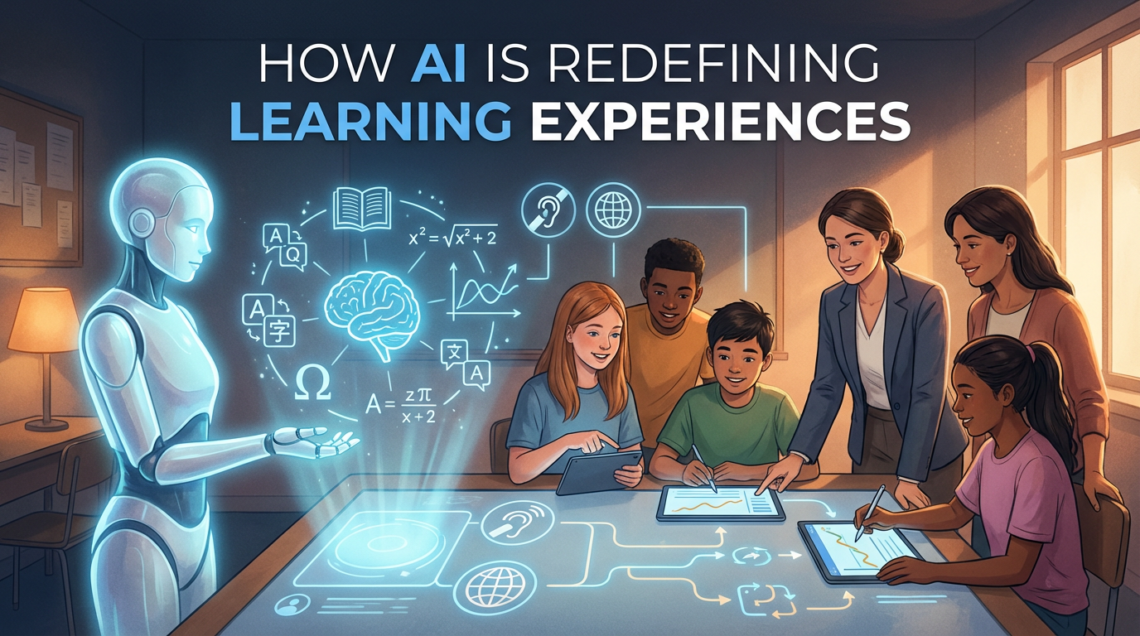
AI in education isn’t just “kids using ChatGPT to finish homework faster.” The real shift is deeper: AI is changing how learning is delivered, how progress is measured, and how teachers spend their time. Done right, it can make learning more personalised, accessible, and engaging. Done wrong, it can widen gaps, amplify bias, and turn education into a surveillance-heavy mess.
Let’s break down what’s actually happening without the hype.
Why AI feels different from past edtech waves
Traditional edtech mostly digitized old workflows: PDFs instead of worksheets, videos instead of lectures, LMS portals instead of folders. AI changes the experience itself by adapting to the learner and generating content, feedback, and pathways on the fly.
Global organizations have been pushing a “human-centered” approach for this reason – AI is powerful, but education still needs human agency, teacher-student relationships, and safeguards.
1) Personalised learning is becoming… actually personalised
One of the biggest promises of AI is that it can meet students where they are. In practical terms, that looks like:
- Adaptive practice that adjusts difficulty in real time
- Personalized explanations in different styles (visual, step-by-step, analogy-based)
- Learning paths that focus on weak concepts instead of repeating what the learner already knows
This is especially useful in large classrooms where a teacher can’t give every student 1:1 attention.
But there’s a catch: personalization only works well if the system has good data, is designed responsibly, and doesn’t “optimize” students into narrow tracks that limit growth. Equity and inclusion concerns show up fast if access or bias isn’t addressed.
2) AI tutoring is scaling 1:1 help (but it’s not a replacement for teachers)
AI tutors can provide instant support: explain a concept, ask guiding questions, generate practice problems, or give feedback on drafts. That reduces the “I’m stuck and too embarrassed to ask” barrier.
The best versions act like a coach, not an answer machine:
- prompting reflection
- encouraging problem-solving
- explaining why something is wrong
Many education frameworks emphasize that AI should support teaching and learning – not substitute the role of educators or reduce human interaction, especially for younger learners.
3) Content creation is faster and more customizable
Teachers spend a huge amount of time creating and adapting materials. AI helps with:
- lesson plan drafts
- reading passages at multiple difficulty levels
- quiz questions and rubrics
- examples, analogies, and practice sets
- translation and language simplification
This is one of the most immediate productivity wins, and it’s being highlighted in major education transformation discussions.
Important: AI-generated content still needs review. Accuracy issues, hallucinations, and cultural/context mistakes are real. The human educator remains the quality gate.
4) Assessment is shifting from “final answers” to “learning process”
AI can evaluate more than multiple-choice results. Newer approaches include:
- formative feedback during learning (not just at the end)
- identifying misconception patterns (where students consistently misunderstand concepts)
- generating targeted remediation activities
- analyzing writing for structure, clarity, and argument quality (with human oversight)
This makes assessment more continuous and supportive less “gotcha,” more “growth.”
At the same time, academic integrity policies are evolving because generative AI makes it easier to produce plausible text quickly. Many toolkits now emphasize updating classroom policies, teaching AI literacy, and redesigning assessments to value reasoning, reflection, and originality.
5) Teachers are getting time back (if schools implement AI responsibly)
In real life, teacher workload is brutal. AI can help reduce repetitive tasks like:
- drafting emails and parent updates
- summarizing student progress
- generating differentiated worksheets
- converting notes into classroom materials
- organizing resources and lesson outlines
But this only helps if:
- schools provide training
- teachers maintain decision-making control
- tools are aligned with curriculum and ethics
OECD and other policy bodies repeatedly flag that teacher capability-building and governance matter as much as the tools themselves.
6) Accessibility and inclusion can improve if equity is treated as core, not optional
AI has real potential to support learners who have historically been underserved:
- text-to-speech and speech-to-text support
- translation and multilingual learning
- simplified explanations for different learning needs
- assistive writing supports
- personalized pacing for neurodiverse learners
But equity cuts both ways. If only some learners have access to high-quality devices, connectivity, and AI tools, gaps widen. If training data is biased, it can harm outcomes for certain groups.
OECD research specifically highlights both the opportunity and the risk: AI can support more inclusive education, but it can also exacerbate disparities without deliberate design and policy.
What’s changing in learning culture
AI is also pushing a mindset shift:
From memorization → to thinking and synthesis
When information is instantly available, the competitive edge becomes:
- asking better questions
- evaluating credibility
- connecting concepts
- applying knowledge to new contexts
That’s why many national and global initiatives focus on AI literacy and future-ready skills, not just “using tools.”
From one-size-fits-all → to flexible learning pathways
AI makes it more normal for learners to take different routes to the same goal. The classroom becomes less about moving in lockstep, more about progress.
The risks (the stuff we can’t ignore)
AI in education has serious downside potential. The big ones:
Privacy and data governance
Education data is sensitive. Systems need clear rules: what’s collected, how it’s stored, who can access it, and how long it’s retained. Responsible AI frameworks increasingly emphasize governance and transparency.
Bias and fairness
If AI tools systematically perform worse for certain accents, dialects, backgrounds, or learning profiles, that becomes unfair at scale. Equity-focused guidance repeatedly warns about this.
Over-reliance and reduced human connection
If AI becomes the “default tutor,” students may lose critical human mentoring and relationship-based support especially harmful for younger learners. UNESCO explicitly stresses protecting human agency and the teacher-student relationship.
Accuracy and misinformation
AI can generate confident-sounding wrong answers. In education, that’s dangerous because learners may not know what to trust.
What “good” AI-powered learning looks like (practical principles)
If you’re building or adopting AI in learning whether as a school, tutor, edtech team, or training provider these principles keep things sane:
- Human in the loop: AI drafts, humans decide.
- Teach AI literacy: students must learn how to question outputs, verify sources, and use AI ethically.
- Design for equity: access plans, inclusive datasets, bias testing, and accommodations aren’t optional.
- Protect privacy by design: minimal data collection, clear policies, and transparency.
- Use AI to deepen learning: focus on reasoning, creativity, and feedback not shortcutting work.
AI won’t replace education – but it will reshape who supports it
AI is changing how learning happens, but the real impact depends on who designs, implements, and governs these systems. The future of education won’t be built by tools alone it will be built by educators, instructional designers, AI trainers, evaluators, and domain experts working alongside technology.
That’s where platforms like Truelancer , upwork, fivver come into the picture.
As organizations, schools, and edtech companies experiment with AI-powered learning, the demand for skilled human support is only growing from curriculum designers and subject-matter experts to AI trainers, content reviewers, and education consultants. Truelancer connects institutions with vetted global talent who understand both education and AI, helping ensure that innovation stays responsible, inclusive, and learner-focused.
Because at the end of the day, the goal isn’t just smarter systems it’s better learning outcomes, powered by the right mix of technology and human expertise.