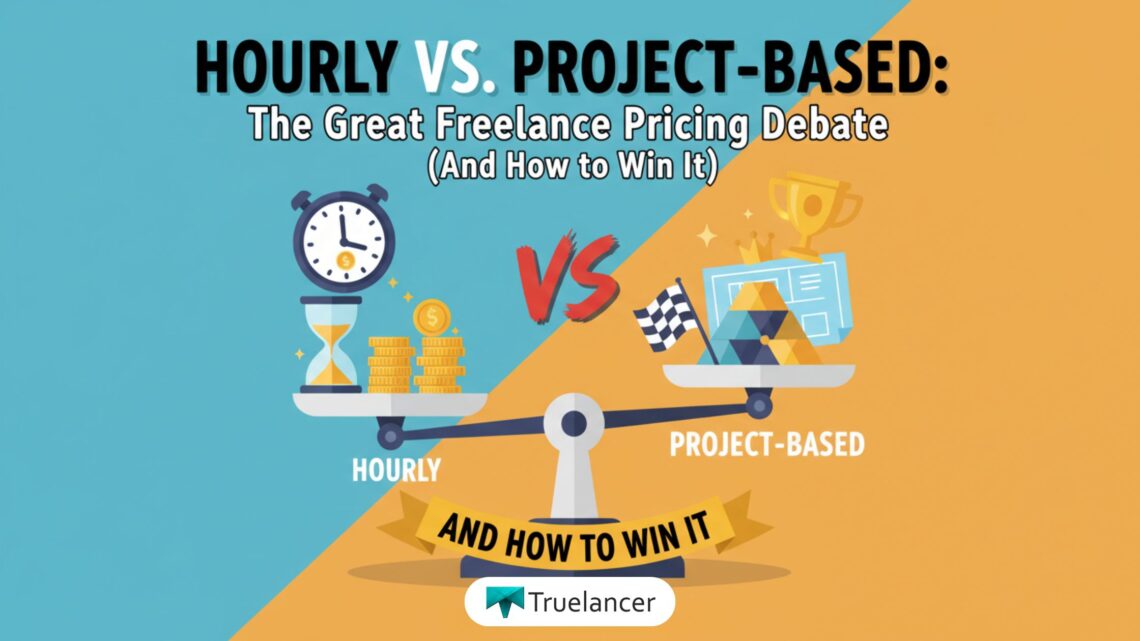
As a freelancer, your pricing strategy is the engine of your business. If the engine is tuned correctly, you cruise toward profitability. If it’s misfiring, you’re stuck on the side of the road, overworked and underpaid.
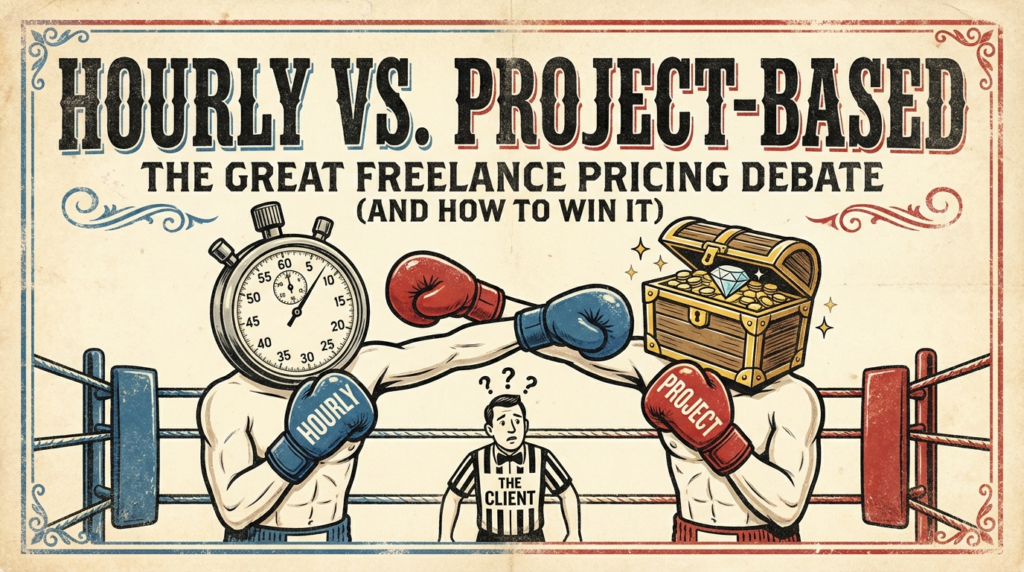
The million-dollar question: Should you sell your time by the hour, or sell the result by the project? The truth is, there is no “correct” answer—only the answer that fits your current season of business. Let’s dive deep into the mechanics of both models so you can stop guessing and start earning.
⏳ Hourly Pricing: The “Safe” Bet for the Uncertain
Hourly billing is the most intuitive way to start. It’s a direct exchange of time for money, much like a traditional job.
The Upside:
- The Safety Net: If a client says “one more quick thing” for the tenth time, your bank account doesn’t suffer. You are compensated for every minute of “brain-drain.”
- Ideal for “Foggy” Projects: When a client says, “I need some help with my marketing,” but can’t define what that help looks like, hourly billing protects you from the unknown.
- Lower Entry Barrier: It’s much easier for a new freelancer to say “$50/hour” than to accurately estimate a complex $3,000 project.
The Downside (The “Efficiency Trap”):
The biggest flaw? It punishes you for being good at your job. If it takes a beginner 10 hours to write an article, and it takes you 2 hours because you’re an expert, you earn 80% less for providing the same (or better) value.
Pro-Tip: If you stay hourly as you get faster, you must raise your rates regularly to account for your increased efficiency.
💼 Project-Based Pricing: The “High-Value” Strategy
Project-based (or value-based) pricing moves the conversation away from the clock and onto the transformation you provide.
The Upside:
- Profitability Scaling: If you quote $2,000 for a website and finish it in 10 hours through smart templates and experience, you’ve just made $200/hour.
- Value Alignment: Clients care about the solution, not how long you sat in your chair. This model encourages you to focus on quality and results.
- Predictable Cash Flow: You know exactly what’s hitting your bank account, making it easier to manage your business expenses.
The Downside (The “Scope Creep” Monster):
Project pricing is a double-edged sword. If you underestimate the work, or if the client keeps adding “small” requests, your hourly rate can quickly plummit to below minimum wage.
The Fix: Success here requires a rock-solid contract and a detailed “Statement of Work” that defines exactly where the project ends.
🔍 Comparison at a Glance
| Feature | Hourly Billing | Project-Based Pricing |
| Best For | Maintenance, Consulting, Support | Websites, Logos, Specific Deliverables |
| Risk Factor | Low (Paid for all time) | High (Underestimating time) |
| Earning Potential | Capped by your hours | Unlimited (via efficiency) |
| Client Relationship | Might feel “watched” | Focuses on the final result |
🛠 Strategic Framework: Which One Should You Choose?
⚡ Use Hourly When:
- The project is “Reactive”: You are fixing bugs, responding to emails, or providing ad-hoc support.
- The Client is a “Tinkerer”: If they like to change their mind every two days, hourly billing ensures you don’t grow to resent them.
- You’re Learning: If you’re new to a niche and don’t know your own pace yet.
🏆 Use Project-Based When:
- The Scope is “Frozen”: You have a clear list of deliverables and a deadline.
- You Have a “Secret Sauce”: You’ve automated part of your process or have a specialized skill that allows you to work faster than the average person.
- The Value is High: If a 1-hour consultation saves a company $10,000, don’t charge them for an hour. Charge them for the $10,000 solution.
✨ The Hybrid “Pro” Move: The Best of Both Worlds
Many elite freelancers have stopped choosing one or the other. Instead, they use a Hybrid Model:
- Phase 1 (Project-Based): Charge a flat fee for the initial build or “Discovery” phase.
- Phase 2 (Hourly/Retainer): Once the main project is done, switch to an hourly rate or a monthly retainer for ongoing maintenance and tweaks.
Final Thoughts
Your pricing isn’t just a number it’s a reflection of your boundaries and your expertise. Don’t be afraid to experiment. Start with what feels safe, but always keep an eye on how you can transition toward value-based pricing as you grow.
Ready to put your skills to the test? Join a community that values your expertise. Create your profile on Truelancer today and start bidding on projects that respect your time and your talent.