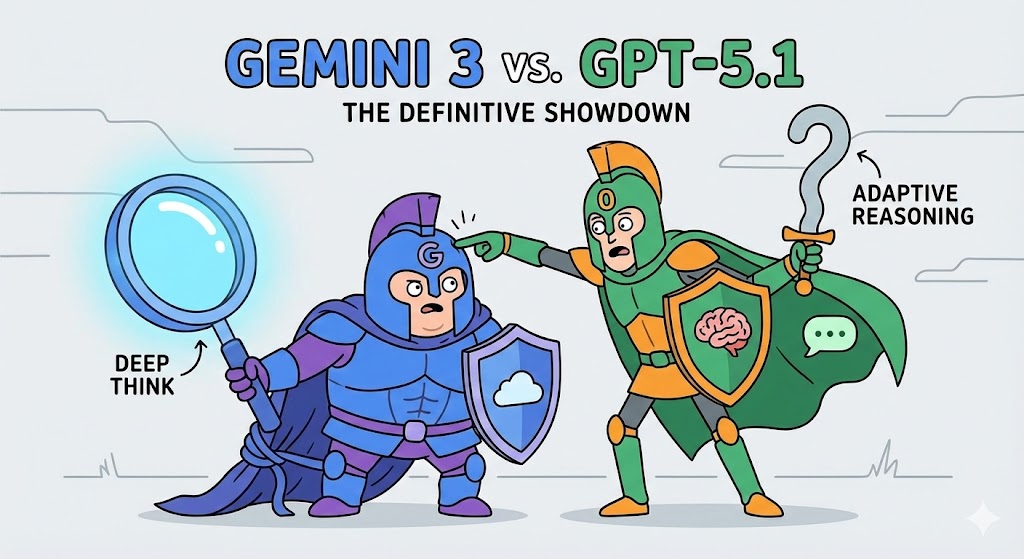
If you’ve been online this past week, you know the AI landscape just shifted beneath our feet. In a span of six days, we saw the release of OpenAI’s GPT-5.1 (Nov 12) and Google’s Gemini 3 (Nov 18), ending the “quiet period” of late 2025 with a bang.
Gone are the days of minor incremental updates. We are now in the era of “Deep Thinking” and “Vibe Coding.” But for the average developer, business owner, or power user, the choice is no longer just about “which model is smarter.” It’s about which model fits your brain.
In this definitive showdown, we’re stripping away the marketing fluff to compare benchmark realities, reasoning capabilities, and the new agentic workflows to help you decide which subscription is worth your $30/month.
1. The Specs at a Glance
Before we dive into the nuance, let’s look at the raw numbers. Google has clearly aimed for dominance in context and multimodal input, while OpenAI is doubling down on adaptive efficiency.
| Feature | Google Gemini 3 | OpenAI GPT-5.1 |
| Release Date | Nov 18, 2025 | Nov 12, 2025 |
| Top Feature | Deep Think (RL-based reasoning) | Adaptive Reasoning (Instant vs. Thinking) |
| Context Window | 2 Million Tokens (Standard) | 400k Tokens (Standard) |
| Coding Capability | “Vibe Coding” / Google Antigravity | GPT-5.1-Codex-Max |
| Multimodal | Native (Audio/Video/Code/Text) | Strong Vision/Voice, Text-first logic |
| Benchmark Star | ARC-AGI-2 (45.1% w/ Deep Think) | SWE-bench Verified (77.9%) |
| Best For… | Complex Research, “Vibe” App Building | Polished Chat, Autonomous Agents |
2. The Battle of the “Thinking” Models
The defining feature of late 2025 AI is inference-time compute—the ability for the model to “pause and think” before responding.
Gemini 3: “Deep Think”
Google’s Deep Think mode isn’t just a slow-down mechanism; it’s a parallel reasoning engine. When you ask Gemini 3 a complex physics problem or a contradictory logic puzzle, it encrypts a “Chain of Thought” that explores multiple possibilities simultaneously before converging on an answer.
- The Win: It crushes “gotcha” questions. In our testing, Gemini 3 solved the Humanity’s Last Exam benchmark with a 37.5% score, nearly 11 points higher than GPT-5.1.
- The Trade-off: It is slow. A Deep Think response can take 15-40 seconds to start streaming.
GPT-5.1: “Adaptive Reasoning”
OpenAI has taken a more user-friendly approach. GPT-5.1 automatically toggles between “Instant” (for simple queries like emails) and “Thinking” (for math/coding).
- The Win: It feels faster and more fluid. You don’t need to manually toggle a setting; the model just knows when to try hard.
- The Trade-off: It sometimes “under-thinks.” We found GPT-5.1 occasionally rushed through complex legal analysis in “Instant” mode, missing nuances that Gemini 3 caught.
3. “Vibe Coding” vs. Traditional Engineering
This is where the two models diverge philosophically.
Gemini 3 & Google Antigravity
Google is betting on “Vibe Coding”—the idea that you shouldn’t need to know Python to build an app. Using the new Google Antigravity IDE, we fed Gemini 3 a napkin sketch of a “Retro 90s Music Player.”
- The Result: It didn’t just write code; it understood the aesthetic. It generated a functional React app with neon gradients and clunky buttons, matching the “vibe” perfectly without specific CSS instructions.
- Who it’s for: Founders, PMs, and creatives who want to prototype instantly.
GPT-5.1 & The Agent Ecosystem
OpenAI is sticking to supporting actual engineers. GPT-5.1 performs slightly better on SWE-bench Verified (bug fixing in real repos). It integrates flawlessly with tools like Cursor and VS Code to act as an autonomous pair programmer.
- The Result: GPT-5.1 is less likely to hallucinate a non-existent library. It writes boring, reliable, production-ready code.
- Who it’s for: Senior engineers and enterprise teams maintaining legacy codebases.
4. The “Human” Element: Chat & Creativity
If you use AI primarily for writing, brainstorming, or therapy, GPT-5.1 is the clear winner.
- Tone: GPT-5.1 has shed the robotic “As an AI language model” vestige. Its “Candid” and “Quirky” personality presets feel shockingly human. It uses sentence fragments, varies its rhythm, and “reads the room.”
- Gemini 3: Still feels like a very smart professor. It’s factual, dense, and structured. Great for drafting a legal brief, but dry for a blog post (ironically).
Winner: GPT-5.1 for vibes (the social kind), Gemini 3 for vibes (the coding kind).
5. Ecosystem Lock-in: The deciding factor
For many, the choice won’t be about the model, but where it lives.
- Team Google: If your life is in Drive, Docs, and Gmail, Gemini 3 is now a non-negotiable upgrade. The new Workspace integration finally works. You can tell Gemini, “Look at the video recording of yesterday’s meet, the Q3 financial sheet, and my emails with Sarah, and draft a project plan.” It works seamlessly because of that massive 2 Million Token context window.
- Team OpenAI/Microsoft: If you live in VS Code, Slack, or maintain a custom RAG (Retrieval-Augmented Generation) pipeline, GPT-5.1’s lower latency and “reliable” agentic behavior make it the safer bet.
The Verdict: Which one should you use?
The “AI war” has resulted in two distinct tools for two different types of work.
Choose Google Gemini 3 if:
- You need to analyze massive amounts of data (videos, long PDFs, codebases).
- You are a “Vibe Coder” who wants to build apps from sketches and loose ideas.
- You need the absolute highest logical reasoning capability for research or science.
Choose OpenAI GPT-5.1 if:
- You want a polished, human-like creative writing partner.
- You are a software engineer who values reliability and bug-fixing over rapid prototyping.
- You prioritize speed and fluid conversation over “Deep Thinking” latency.
My recommendation? Keep your GPT Plus subscription for daily driver tasks, but open a Google AI Studio tab when you need to solve the “impossible” problems.
Ready to test them yourself?
- Try This: Take a photo of your messiest bookshelf.
- Ask Gemini 3: “Catalog these books and recommend 3 more based on the vibe of this collection.” (Tests Multimodal + Vibe)
- Ask GPT-5.1: “Create a witty, sarcastic Craigslist ad to sell this entire collection as a ‘starter pack for pseudo-intellectuals’.” (Tests Creative Tone)
Beyond the Model: Execution is Everything
Whether you choose Gemini 3’s deep reasoning or GPT-5.1’s creative flair, the reality of 2025 is clear: The tool is only as good as the operator.
Having access to “Vibe Coding” or “Deep Think” capabilities doesn’t automatically build your business. You still need skilled developers to architect the system, prompt engineers to optimize the reasoning chains, and creative experts to curate the output.
Don’t have time to master these new APIs yourself?
That’s where Truelancer comes in. As the world’s leading curated freelance marketplace, Truelancer is already home to the next generation of AI-native talent.
- Need a “Vibe Coder”? Hire developers who are already building rapid prototypes with Google Antigravity.
- Need an Agent Architect? Find engineers who can integrate GPT-5.1 into your existing enterprise stack.
- Need Content Strategy? Connect with writers who know how to leverage AI without sounding like a robot.
Stop paying for subscriptions you don’t have time to use.
👉 Post a Project on Truelancer today and hire the experts who are already mastering Gemini 3 and GPT-5.1.