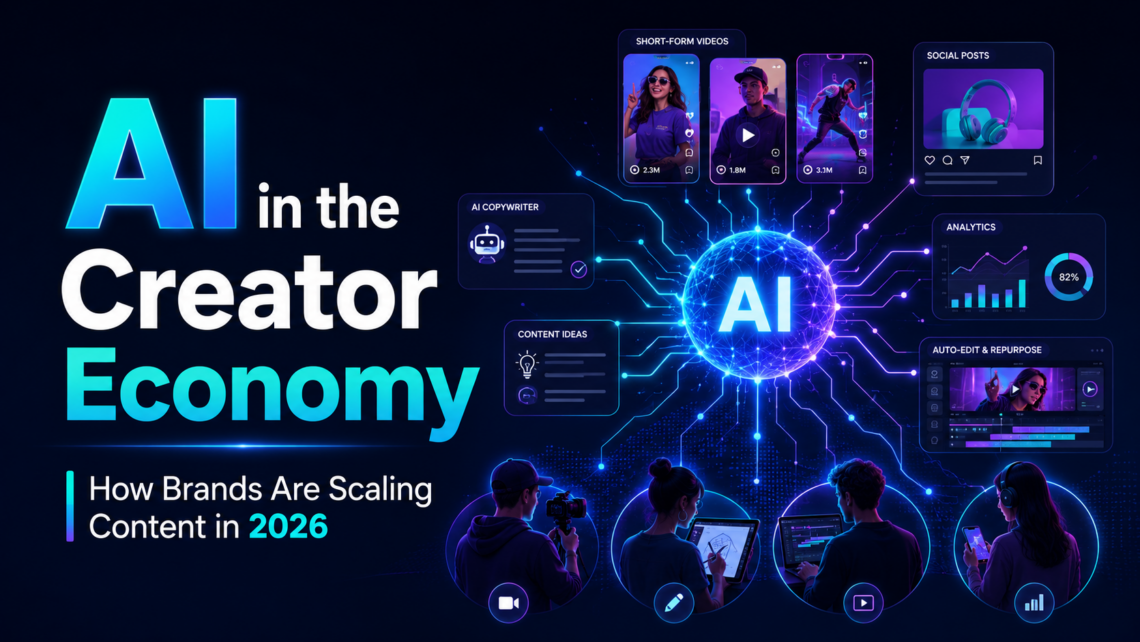
🚀 Introduction: Content Demand Has Gone Nuclear
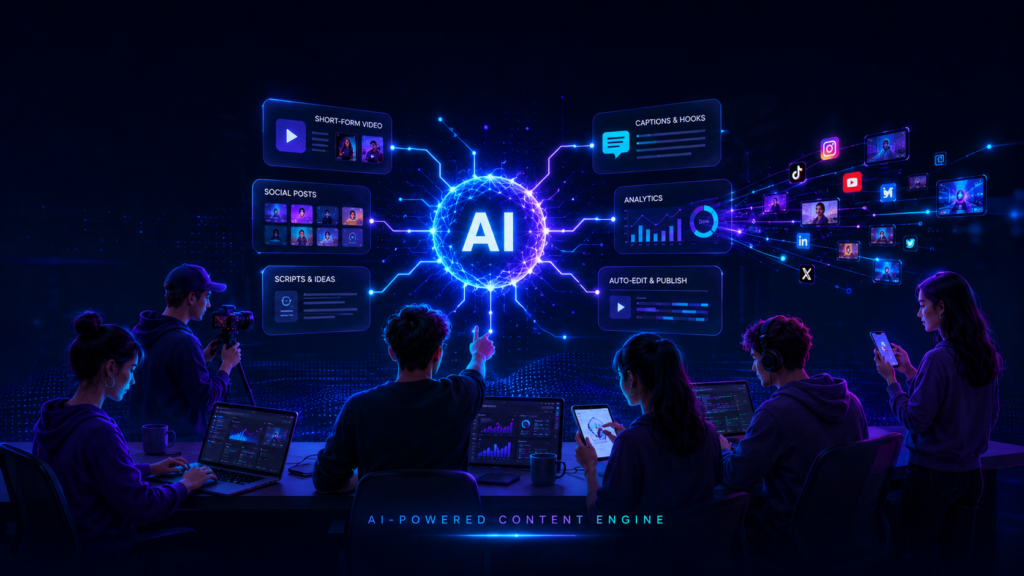
In 2026, content is no longer just a marketing activity.
It has become business infrastructure.
Every brand today is expected to show up everywhere — consistently, creatively, and in real time. From Instagram Reels and YouTube Shorts to LinkedIn posts, UGC videos, ads, blogs, newsletters, and product explainers, the demand for content has exploded.
Brands are now expected to:
- Post daily across multiple platforms
- Create short-form videos at scale
- Personalize messaging for different audiences
- Stay relevant with fast-moving trends
- Repurpose one idea into multiple formats
- Maintain a consistent brand voice everywhere
And here’s the reality:
Traditional content teams cannot keep up anymore.
A small in-house team can only create so much. Agencies can be expensive and slow. Hiring full-time specialists for every content need is not practical for most businesses.
This is where the shift is happening.
AI + the creator economy is redefining how content is produced, distributed, and scaled.
Instead of relying only on large in-house teams or traditional agencies, companies are now building flexible content engines powered by AI tools, freelance creators, UGC talent, video editors, scriptwriters, designers, and social media experts.
The future of content is not just about creating one great campaign.
It is about building a system that can create great content consistently, quickly, and at scale.
📊 The Rise of the Creator Economy in 2026
The creator economy is no longer limited to influencers posting lifestyle videos, brand collaborations, or viral reels.
That version still exists, but the bigger shift is happening behind the scenes.
In 2026, creators are becoming an essential part of how brands produce content every single day. Businesses now rely on creators not just for visibility, but for consistent content production across platforms.
From Influencers to Content Production Teams
The creator economy has evolved far beyond people with large social media followings.
Today, it includes a wide range of skilled professionals such as:
- UGC creators who make authentic product videos
- Short-form video editors who turn ideas into scroll-stopping reels
- Scriptwriters who create hooks, ad scripts, and storytelling formats
- Designers who build thumbnails, carousels, and campaign creatives
- Social media strategists who understand algorithms and audience behavior
- AI-assisted content creators who use tools to produce faster and smarter
The major shift is simple:
Brands are no longer only asking, “Who has the biggest audience?”
They are asking, “Who can help us create better content, faster, and at scale?”
A creator with 2,000 followers but strong video production skills can now be more valuable to a brand than an influencer with 200,000 followers but limited content output.
That is the real transformation.
Brands do not just need reach anymore. They need:
- More content
- Faster turnaround
- Platform-specific creativity
- Consistent posting
- Authentic storytelling
This is why creators are becoming content partners, not just promotional faces.
📈 What Is Driving the Growth of the Creator Economy?
Several major changes are pushing the creator economy into a new phase.
1. Short-Form Content Has Exploded
Platforms like Instagram Reels, YouTube Shorts, and TikTok have trained audiences to consume quick, engaging, high-frequency content.
For brands, this means one campaign is no longer enough.
They need multiple videos, hooks, captions, and creatives to stay visible.
2. Attention Spans Are Getting Shorter
Audiences decide within seconds whether to keep watching or scroll away.
This has increased the demand for creators who understand strong hooks, fast storytelling, and platform-native content.
3. Algorithms Reward Consistency
Posting occasionally no longer works.
Social platforms reward brands that publish regularly and keep users engaged. This means businesses need a steady flow of fresh content every week, and sometimes every day.
4. Brands Are Moving from Ads to Creator-Led Content
Audiences are becoming less responsive to overly polished brand ads.
They trust content that feels real, relatable, and human. That is why businesses are investing more in UGC creators, freelance video editors, and creator-led campaigns.
The Big Challenge: Content Demand Is Outpacing Supply
Here is the problem:
Brands need more content than ever, but most internal teams cannot keep up.
They need content for:
- YouTube
- TikTok
- Ads
- Email campaigns
- Landing pages
- Product launches
And each platform needs a different style, format, and message.
This is where the gap appears:
Content demand is growing faster than traditional teams can produce it.
Without AI tools and flexible creator talent, brands struggle to stay consistent.
That is why the creator economy in 2026 is not just about popularity.
It is about building a scalable content engine.
🤖 How AI Is Transforming Content Creation
AI is not replacing creators.
It is turning creators into faster, smarter, and more scalable content teams.
Earlier, one creator could spend hours planning an idea, writing a script, editing a video, adding subtitles, creating captions, and repurposing the same content for different platforms.
Now, AI can support almost every step of that workflow.
The result is simple:
Creators can focus more on creativity, storytelling, and brand voice, while AI handles repetitive, time-consuming tasks in the background.
1. ⚡ Faster Content Production
One of the biggest advantages of AI is speed.
Content creation used to move slowly because every step required manual effort. A single short-form video could involve brainstorming, scripting, editing, caption writing, thumbnail planning, and platform formatting.
AI tools now help with:
- Script generation
- Caption writing
- Hook ideas
- Thumbnail concepts
- Blog outlines
- Social media post drafts
- Content repurposing
- Hashtag suggestions
This does not mean AI creates perfect content on its own.
It means creators no longer have to start from a blank page.
For example, a social media manager can use AI to generate 10 caption ideas in minutes, then refine the best ones based on brand tone and audience behavior.
A video creator can turn one campaign idea into multiple scripts for Reels, Shorts, TikTok, and LinkedIn.
What used to take hours can now be completed in minutes.
That speed gives brands a major advantage because they can test more ideas, publish more consistently, and respond faster to trends.
2. 🎬 Scalable Video Creation
Video is now the center of modern content marketing.
But video production is also one of the most time-consuming parts of content creation.
This is where AI is changing the game.
With AI-powered tools, creators can:
- Auto-generate subtitles
- Remove background noise
- Edit clips faster
- Create AI voiceovers
- Translate videos into different languages
- Turn long videos into short clips
- Resize content for different platforms
- Repurpose webinars, podcasts, and interviews into multiple assets
This means one piece of content no longer stays as one piece of content.
A single webinar can become:
- 5 short-form videos
- 3 LinkedIn posts
- 2 Instagram reels
- 1 blog article
- Multiple quote graphics
- Email newsletter content
One content idea can become 10+ platform-ready outputs.
For brands, this means higher content output without needing a massive production team.
For creators, it means they can deliver more value in less time.
3. 🎯 Data-Driven Content Strategy
Before AI, a lot of content strategy depended on assumptions.
Brands would post content, wait for results, and then try to understand what worked.
Now, AI makes content strategy more data-driven.
AI tools can help brands:
- Identify trending topics
- Study competitor content
- Analyze audience behavior
- Predict what type of content may perform better
- Find the best posting times
- Track engagement patterns
- Understand which hooks, captions, and formats drive results
This gives creators and marketing teams a clearer direction.
Instead of guessing what the audience wants, brands can make decisions based on real signals.
For example, if short educational videos are performing better than promotional videos, AI can help identify that trend early. The brand can then create more educational content before competitors catch up.
Content is no longer just guesswork. It is becoming data-backed execution.
The best creators in 2026 are not only creative. They also understand performance, analytics, and audience behavior.
4. 🌍 Hyper-Personalization at Scale
Personalization used to be difficult because creating different content for different audiences required too much time and effort.
AI has changed that.
Brands can now create content that is more relevant for specific regions, languages, customer groups, and platforms.
With AI, businesses can produce:
- Region-specific content
- Language-specific videos
- Audience-targeted messaging
- Personalized email content
- Localized ad creatives
- Platform-specific captions
- Different versions of the same campaign for different buyer personas
For example, a brand can create one product video and then adapt it for different countries, languages, and audience segments.
The message stays consistent, but the delivery feels more relevant to each audience.
This is personalization at scale.
And in 2026, this matters because audiences expect content that feels made for them.
Generic content gets ignored.
Relevant content gets attention.
The Bigger Shift: AI Makes Creators More Valuable
The most important point is this:
AI is not removing the need for creators. It is increasing the demand for creators who know how to use AI well.
Brands still need human creativity, emotion, storytelling, cultural understanding, and taste. AI can speed up the process, but humans decide what feels authentic, what fits the brand, and what will connect with the audience.
The winning formula is:
Human creativity + AI efficiency = scalable content creation
That is why the future of content creation is not AI alone.
It is AI-powered creators.
👥 The New Creator Workforce
Here’s the twist:
AI did not reduce the need for creators.
It created more demand for specialized creator talent.
As brands scale their content operations, they need people who understand both creativity and digital execution. The new creator workforce is not just made of influencers. It includes professionals who can plan, produce, edit, optimize, and distribute content across platforms.
💼 Emerging Creator Roles in 2026
Instead of hiring only generic “content creators,” companies are now hiring for more specialized roles such as:
- AI content strategists
- UGC video creators
- Short-form video editors
- Prompt-based scriptwriters
- Influencer campaign managers
- Content automation specialists
- Social media performance analysts
- Creative project managers
Many of these roles are freelance, remote-first, and project-based.
This gives brands more flexibility.
Instead of building a large full-time content department, companies can work with different specialists depending on the campaign, platform, or audience they want to target.
🔥 Why Brands Are Moving to Freelancers + AI
The combination of freelancers and AI gives brands something traditional teams often struggle with:
Speed, flexibility, and scale.
Here is why businesses are making the shift.
1. 💸 Cost Efficiency
Hiring a large in-house content team can be expensive.
A brand may need writers, video editors, designers, strategists, social media managers, and campaign specialists. Hiring all of them full-time is not always practical.
With freelancers and AI tools, brands can reduce costs while increasing output.
Instead of hiring one large full-time team, a company can work with multiple freelance creators and use AI to speed up production.
Lower cost. Higher output. Better flexibility.
That is the main advantage.
2. ⚡ Speed and Scalability
Freelancers allow brands to scale campaigns quickly.
If a company needs 30 videos for a product launch, it does not have to wait months to hire a full team. It can work with multiple freelance creators and editors at once.
Freelancers help brands:
- Launch campaigns faster
- Scale content production instantly
- Test multiple creative ideas
- Handle seasonal content demand
- Avoid long-term hiring commitments
When combined with AI, this becomes even more powerful.
AI speeds up ideation, editing, captions, repurposing, and optimization.
Freelancers bring the creativity and execution.
Together, they help brands move faster than traditional workflows.
3. 🌍 Global Talent Access
Companies are no longer limited by location.
A brand can hire:
- Video editors from India
- Designers from Europe
- Writers from the US
- UGC creators from different regions
- Social media strategists from global markets
This gives businesses access to diverse creative styles, languages, and cultural perspectives.
For global brands, this is especially useful.
They can create content that feels local, even when the brand operates internationally.
4. 🎯 Specialized Skills
Modern content marketing is no longer one-size-fits-all.
A LinkedIn post needs a different approach from a TikTok video. A UGC ad needs a different style from a polished brand film. A product demo needs a different script from an awareness campaign.
That is why brands now prefer specialists.
They want:
- Niche experts
- Platform-specific creators
- Performance-driven content producers
- Short-form video specialists
- UGC creators
- AI-assisted content professionals
Instead of hiring one generalist to do everything, companies can bring in the right expert for the right task.
That is a smarter way to scale.
📱 UGC vs Influencers: The Big Shift
One of the biggest changes in 2026 is this:
Brands care less about followers and more about content.
Earlier, influencer marketing was mostly about reach. Brands paid creators with large audiences to promote products.
But now, many businesses are realizing that follower count does not always guarantee performance.
What matters more is whether the content feels authentic, engaging, and useful.
This is where UGC creators are winning.
🧩 Why UGC Creators Are Winning
UGC stands for User-Generated Content.
UGC creators make content that looks and feels like it comes from real customers. They do not need a massive audience. Their main value is their ability to create relatable, authentic content for brands.
UGC creators usually focus on:
- Product demos
- Review videos
- Testimonial-style content
- Unboxing videos
- App walkthroughs
- Lifestyle product shots
- Short-form ads
Brands prefer UGC creators because they are:
- More affordable
- More relatable
- Easier to scale
- Better suited for performance ads
- Faster to work with
A UGC creator does not need to post the content on their own profile. In many cases, brands buy the content and use it on their own social media pages, ads, or landing pages.
That makes UGC highly scalable.
📉 How the Traditional Influencer Model Is Changing
The traditional influencer model is not dead, but it is changing.
Instead of paying one influencer a huge amount for one post, brands are now working with multiple creators and testing different content formats.
Earlier, a brand might spend ₹2–5 lakh on one influencer collaboration.
Now, the same brand may work with 20–50 creators, produce bulk content, test different creatives, and use the best-performing ones in ads.
This is a portfolio approach to content.
Instead of betting everything on one influencer, brands create multiple content assets and let performance data decide what works.
That is smarter, faster, and more scalable.
🤖 AI + Creators = The Hybrid Model
The winning formula in 2026 is not AI alone.
It is not creators alone either.
The real advantage comes from combining both.
Human creativity + AI efficiency = the hybrid content model.
In this model, creators use AI to work faster, but humans still guide the creative direction.
Here’s what it looks like:
- A creator uses AI to generate ideas
- AI helps create scripts and captions
- AI speeds up editing and repurposing
- The human creator adds emotion, originality, and cultural context
- Content gets optimized and distributed across platforms
The result?
10x productivity per creator.
AI handles repetitive work.
Creators handle taste, storytelling, and connection.
That is why the hybrid model is becoming the future of content production.
📈 Industry Use Cases: Where AI + Creators Are Making an Impact
The AI-powered creator economy is not limited to one industry.
Brands across sectors are using creators and AI tools to scale content faster.
🛍️ E-commerce and D2C Brands
E-commerce and D2C companies need a constant flow of content to sell products online.
They use creators for:
- Product demos
- Review videos
- UGC ads
- Unboxing content
- Lifestyle product videos
- Before-and-after content
AI helps them repurpose these videos into ads, captions, thumbnails, and platform-specific creatives.
For D2C brands, this is especially powerful because fresh content can directly improve ad performance and conversions.
💻 SaaS Companies
SaaS brands use content to educate, explain, and build trust.
They need content that makes complex products easier to understand.
Creators and AI help SaaS companies produce:
- Educational videos
- LinkedIn creator posts
- Product explainers
- Tutorial clips
- Founder-led content
- Case study snippets
- Webinar repurposing content
A single webinar or product demo can be turned into multiple short videos, posts, blogs, and email assets.
That means more visibility with less manual effort.
🏥 Healthcare and EdTech
Healthcare and EdTech brands need content that is clear, trustworthy, and easy to understand.
Creators help simplify complex topics, while AI helps scale content across formats and languages.
Common use cases include:
- Awareness campaigns
- Explainer videos
- Regional content
- Educational reels
- Course promotion videos
- Patient or student-friendly content
For these industries, personalization and localization are especially important.
AI makes it easier to adapt content for different regions, languages, and audience groups.
⚠️ Challenges in the AI-Powered Creator Economy
Let’s keep it real.
This shift is powerful, but it is not perfect.
Brands need to manage AI and creator workflows carefully to get the best results.
1. Content Saturation
More creators and more AI tools mean more content everywhere.
That also means more noise.
If every brand is posting constantly, average content will not stand out.
Brands need better strategy, not just more volume.
The focus should be on:
- Stronger storytelling
- Better hooks
- Clearer messaging
- Audience relevance
- Platform-native formats
Because more content does not automatically mean better content.
2. Quality Control
Freelance creators and AI tools can help brands scale quickly, but quality can become inconsistent if there is no clear direction.
Brands need strong content guidelines, briefs, review systems, and approval processes.
Without that, content may feel scattered or off-brand.
To maintain quality, businesses need:
- Clear brand guidelines
- Strong creative briefs
- Defined tone of voice
- Content review workflows
- Performance tracking
- Feedback loops
AI can speed up production, but humans still need to manage quality.
3. Authenticity Concerns
Overusing AI can make content feel robotic.
Audiences can quickly sense when content lacks emotion, originality, or human touch.
That is why creators remain important.
The best content still needs:
- Real experience
- Human emotion
- Cultural context
- Storytelling
- Personality
- Taste
AI can help create faster, but authenticity still comes from people.
🔮 Future Outlook: Where This Is Heading
By 2027 and 2028, AI-first content workflows will likely become standard across marketing teams.
More creators will use automation tools as part of their everyday workflow. More brands will build flexible content teams using freelance talent. And content production will become more systemized, measurable, and scalable.
We will likely see:
- AI-first content workflows becoming common
- More creators using automation tools
- Brands building content supply chains
- Increased demand for hybrid creator roles
- More regional and multilingual content production
- Faster testing of creative ideas
- Stronger focus on content performance
The big prediction is simple:
Companies will not compete on product alone. They will compete on content velocity and content quality.
The brands that can produce better content faster will have a clear advantage.
🎯 What This Means for Businesses
If you are a brand, the message is clear.
You need more content than ever.
You need it faster.
You need it cheaper.
You need it smarter.
And you need it across multiple platforms, formats, languages, and audience segments.
Traditional content workflows alone may not be enough anymore.
The solution is to combine:
AI tools + freelance creators + strong content strategy
That combination allows businesses to create more content, test more ideas, reduce production time, and stay visible in a crowded digital market.
💼 How Truelancer Helps You Scale Content
Scaling content does not mean you have to build a massive in-house team.
With Truelancer, businesses can connect with skilled freelance professionals who can support different parts of the content production process.
At Truelancer, businesses can hire:
- AI-powered content creators
- UGC video creators
- Social media managers
- Influencer campaign specialists
- Video editors
- Graphic designers
- Scriptwriters
- Content strategists
- Digital marketing experts
Whether you need short-form videos, social media content, UGC ads, blog content, campaign creatives, or AI-assisted content workflows, Truelancer gives you access to flexible talent on demand.
All in one place. Built for speed, scale, and flexibility.
🚀 Ready to Scale Your Content with AI and Freelance Creators?
Content demand is not slowing down.
The brands that win in 2026 will be the ones that build faster, smarter, and more flexible content systems.
If you want to scale your content production without increasing full-time hiring costs, freelance creators and AI-assisted workflows can help you move faster.
Hire expert content creators, video editors, social media managers, and marketing professionals on Truelancer today.
👉 https://www.truelancer.com/hire-freelancers
🧩 Conclusion: The Creator Economy Is Becoming a Content Engine
The creator economy is no longer just about individual influencers.
It is about:
- Systems
- Scale
- Speed
- Creativity
- Distribution
- Performance
And AI is the engine powering this transformation.
The brands that win in 2026 will not be the ones creating the best content once.
They will be the ones creating great content consistently, at scale.
AI makes the process faster.
Creators make the content human.
Together, they are shaping the future of brand content.
Based on your uploaded draft and expanded sections.