The AI Model Isn’t Your Biggest Problem
When businesses decide to adopt AI, the first discussion almost always sounds the same:
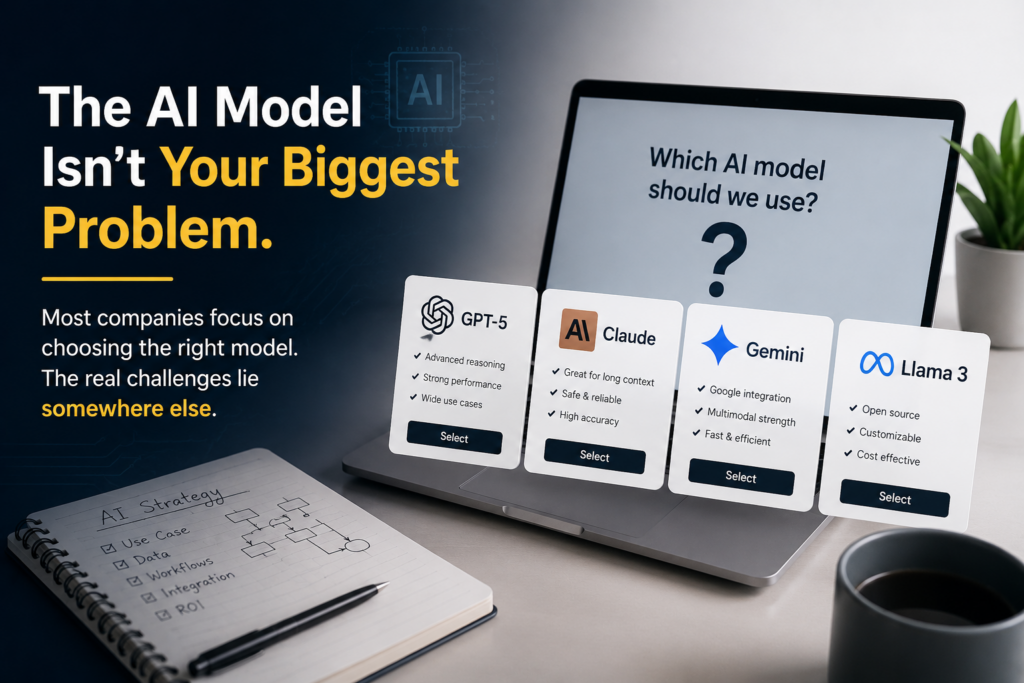
“Should we use GPT-5, Claude, Gemini, or an open-source model?”
It’s a reasonable question but it’s rarely the one that determines whether an AI project succeeds.
Today’s leading AI models are incredibly capable. They can write content, analyze documents, generate code, summarize reports, and automate repetitive tasks with impressive accuracy. While each model has its own strengths, the performance gap between them is often much smaller than businesses imagine.
Yet many companies spend weeks comparing benchmarks, testing prompts, and debating which model is “best,” believing that choosing the right one will guarantee success.
In reality, most AI projects don’t fail because the model was wrong.
They fail because the business never solved the problems around the model.
An advanced AI system can’t compensate for disorganized data, unclear workflows, inconsistent processes, or a lack of human oversight. If employees don’t know where information lives, if documentation is outdated, or if tasks aren’t clearly defined, even the most advanced AI will struggle to deliver reliable results.
Think of AI as a high-performance engine. Installing a powerful engine in a car with flat tires and no steering won’t make it faster it will simply expose the existing problems more quickly.
The companies seeing the biggest returns from AI aren’t necessarily using a different model than everyone else. They’re using the same technology on top of well-organized data, clear processes, and thoughtfully designed workflows. That’s where the real competitive advantage begins.
What Actually Breaks AI Projects
If the AI model isn’t the problem, what is?
In most cases, the answer isn’t technical it’s operational.
Companies often expect AI to transform their business overnight, but they skip the foundational work that makes AI effective. The result? A powerful model with little impact.
Here are the most common reasons AI projects fail:
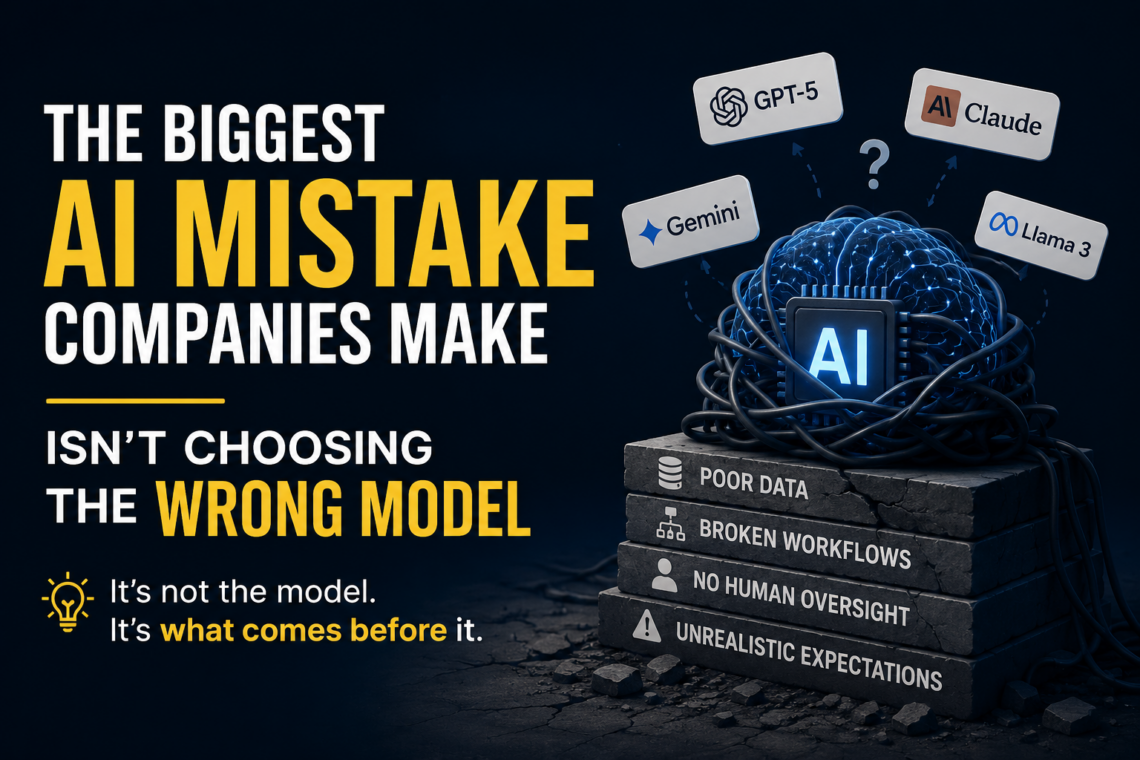
1. Poor Data Quality
AI can only work with the information it’s given. If your data is outdated, incomplete, duplicated, or scattered across multiple tools, the AI’s output will reflect those same issues. Clean, structured, and accessible data is the foundation of every successful AI implementation.
2. Broken or Undefined Workflows
Many businesses try to automate processes that were never clearly documented in the first place. If your team follows different steps for the same task, AI has no consistent process to learn from. Automation works best when the workflow is already efficient and repeatable.
3. No Human Oversight
AI is excellent at accelerating work, but it’s not a replacement for judgment. Without human review, businesses risk publishing inaccurate content, making poor decisions, or delivering inconsistent customer experiences. The most effective teams treat AI as a collaborator—not a decision-maker.
4. Solving the Wrong Problem
Some companies adopt AI simply because it’s trending. Instead of identifying a specific business challenge, they search for places to use AI. Successful organizations take the opposite approach—they start with a real problem and then determine whether AI is the right solution.
5. Unrealistic Expectations
AI isn’t a plug-and-play magic tool. It requires testing, iteration, feedback, and continuous improvement. Companies that expect instant perfection are often disappointed, while those that refine their workflows over time see the greatest long-term value.
At its core, AI doesn’t create efficient businesses—it amplifies them. If your processes are well-designed, AI helps you scale faster. If they’re disorganized, AI simply makes those inefficiencies more visible.
AI Amplifies Existing Processes It Doesn’t Fix Them
One of the biggest misconceptions about AI is that it can solve broken business processes on its own.
It can’t.
AI is an amplifier. It makes good systems faster, smarter, and more efficient. But if the underlying process is messy, AI simply scales the mess.
Imagine a customer support team that doesn’t have a centralized knowledge base. Every support agent answers the same question differently because there are no documented guidelines. Adding an AI chatbot to this setup won’t magically create consistency. Instead, the chatbot may deliver different answers, confuse customers, and increase the workload for the support team.
The same applies across every department.
If your sales process is inconsistent, AI-generated emails won’t improve conversions. If your marketing team lacks a clear content strategy, AI will produce more content but not necessarily better content. If your developers work with outdated documentation, AI coding assistants will still struggle to generate reliable solutions.
The companies seeing the biggest gains from AI don’t start by asking, “Which AI model should we use?”
They start by asking:
- Is our process clearly defined?
- Do we have accurate and accessible data?
- Can this task be standardized?
- Where can AI remove repetitive work while humans focus on decision-making?
Once these questions are answered, AI becomes a force multiplier rather than a temporary shortcut.
The most successful businesses don’t use AI to replace people—they use it to eliminate repetitive work, accelerate execution, and give skilled professionals more time to focus on creativity, strategy, and solving complex problems.
That’s where AI delivers its greatest value—not by fixing broken systems, but by making well-designed systems exponentially more powerful.
What Successful Companies Do Differently
The companies getting real value from AI aren’t winning because they chose a better model.
They’re winning because they built a better system.
Instead of chasing every new AI release, they focus on creating a strong foundation before introducing automation. They document workflows, organize their data, identify repetitive tasks, and bring in the right expertise to implement AI where it creates measurable value.
Their approach is simple:
- Start with a business problem, not an AI tool.
- Clean and organize your data before expecting AI to deliver accurate results.
- Standardize workflows so AI has a clear process to support.
- Keep humans involved in critical decisions and quality checks.
- Measure results, iterate, and improve continuously.
AI isn’t a shortcut to fixing broken operations. It’s a multiplier for businesses that already understand how they work.
That’s why the most successful AI initiatives combine technology with skilled professionals. Developers, data engineers, automation experts, designers, marketers, and domain specialists all play a role in turning AI from an interesting experiment into a real business advantage.
As AI continues to evolve, choosing between GPT, Claude, Gemini, or the next breakthrough model will become less important than one question:
Is your business ready to make the most of AI?
Because in the end, the companies that succeed won’t be the ones with the newest AI model—they’ll be the ones with the smartest processes, the right people, and a clear strategy for using AI to solve real problems.
Final Thoughts
The AI conversation has been dominated by one question:
“Which model should we choose?”
But the companies seeing the biggest returns from AI are asking a different question:
“How can we build better systems around AI?”
The reality is that today’s leading AI models are already incredibly powerful. What separates successful businesses isn’t access to better technology it’s the ability to combine that technology with clear workflows, quality data, and skilled people who know how to turn ideas into results.
AI isn’t replacing strategy. It isn’t replacing good processes. And it certainly isn’t replacing expertise.
It’s simply making all three more valuable.
So before spending weeks comparing AI models, take a closer look at the foundation of your business. Because the biggest competitive advantage in the AI era won’t come from choosing the “perfect” model it will come from building processes that allow any great model to succeed.
In the end, AI is only as effective as the system it’s built into.