
Introduction: The Transformation of Telecalling in the AI Era
Customer communication has always been a critical driver of business growth. For decades, telecalling played a central role in sales outreach, customer support, and lead qualification. Large call centers staffed with hundreds of agents manually dialing prospects formed the operational backbone of industries such as insurance, financial services, real estate, and software sales.
Today, however, the customer support landscape is undergoing a major transformation. Advances in artificial intelligence are enabling companies to deploy AI voice agents capable of conducting natural, real-time conversations with customers at scale. Powered by technologies such as neural text-to-speech (TTS), natural language processing, speech analytics, and machine learning-based intent detection, these systems can answer customer queries, qualify leads, schedule appointments, and route complex conversations to human representatives when needed.
Rather than eliminating human roles, this technological shift is creating a hybrid communication ecosystem. AI voice agents now manage high-volume and repetitive interactions, while human telecallers focus on more complex conversations that require persuasion, empathy, and relationship-driven engagement.
This new operational model is also reshaping workforce dynamics in the customer support industry. As AI systems generate and filter large volumes of customer interactions, companies increasingly rely on flexible gig telecalling workforces to handle qualified conversations. Freelance telecallers step in to manage high-intent leads and customer interactions that require human expertise.
As a result, the telecalling industry is transitioning from a labour-intensive call center model into a scalable AI-assisted customer support infrastructure, combining automation with distributed human talent to deliver faster and more efficient customer engagement.
Key Takeaways: AI Is Expanding Telecalling Opportunities
- The global call and contact center outsourcing market was valued at about $97 billion in 2024 and is projected to reach more than $163 billion by 2030, reflecting strong demand for outsourced customer engagement services.
(Source: Grand View Research) - The AI call center technology market is expected to grow from roughly $2.4 billion in 2025 to more than $13.5 billion by 2034, as companies increasingly adopt automation in customer support and sales outreach.
(Source: Fortune Business Insights) - AI-powered automation can reduce call center operating costs by up to 30% while improving agent productivity and response times.
(Source: McKinsey & Company) - AI systems can manage large-scale outreach while human agents focus on high-value sales and relationship-driven interactions.
- As automated outreach generates more leads, companies increasingly rely on freelance telecallers and gig workers to manage high-intent conversations.
What Are AI Voice Agents in Customer Support?
AI telecalling today is better understood as the use of AI voice agents within modern customer support systems. These agents are powered by conversational AI technologies that allow them to conduct natural, real-time phone conversations with customers.
Unlike traditional automated calling systems, modern AI voice agents combine several advanced technologies, including neural text-to-speech (TTS), automatic speech recognition (ASR), natural language processing (NLP), and large language models (LLMs). Together, these technologies enable AI systems to understand customer queries, generate contextual responses, and carry out structured conversations that closely resemble human interaction.
In customer support environments, AI voice agents can manage a wide range of tasks such as answering frequently asked questions, verifying customer information, scheduling appointments, collecting feedback, and qualifying potential leads. Because these systems can handle thousands of conversations simultaneously, they allow businesses to scale customer communication far beyond the limits of traditional call centre operations.
The Rise of Human-Sounding AI Voice Technology
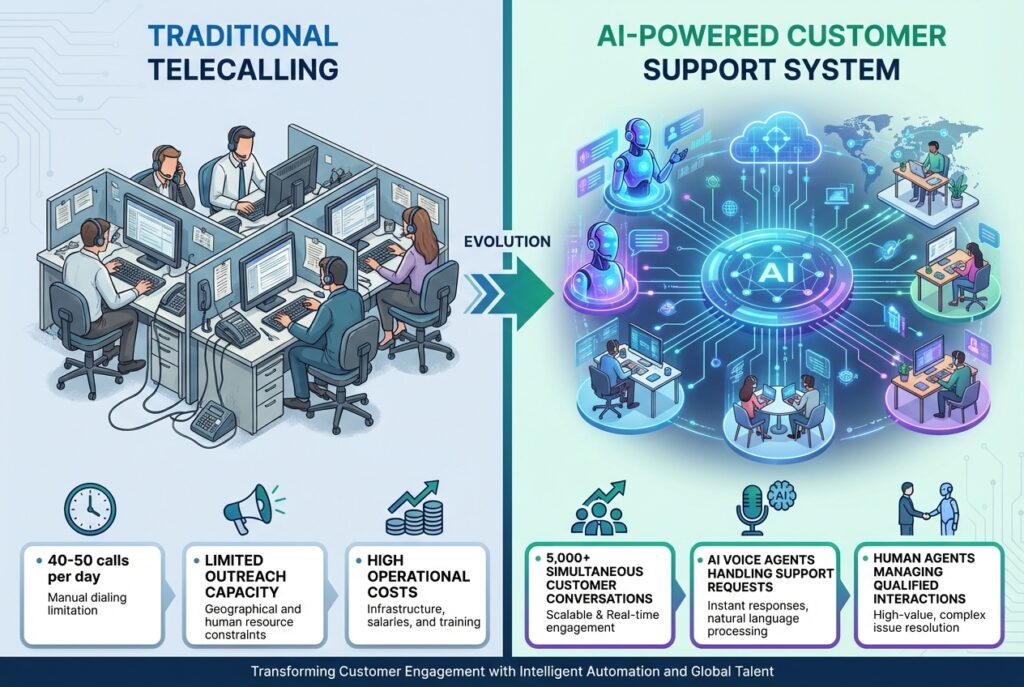
One of the key factors driving the adoption of AI customer support systems is the rapid advancement of natural-sounding speech generation technology.
Earlier automated calling systems often sounded robotic and limited in conversational ability. However, recent breakthroughs in neural text-to-speech (Neural TTS) have significantly improved the realism and expressiveness of AI-generated voices.
Want to Experience AI Voice Agent Technology?
Several platforms allow businesses and developers to experiment with AI voice agents capable of conducting real-time customer conversations.
Some widely used platforms include:
ElevenLabs
A leading AI voice technology company specializing in highly realistic neural speech synthesis.
https://elevenlabs.io
PlayHT
Provides advanced AI voice generation tools used in conversational applications and voice automation systems.
https://play.ht/
Vapi
A communication automation platform enabling businesses to build scalable AI-driven customer communication workflows.
https://vapi.ai/
These technologies enable businesses to deploy AI voice agents capable of conducting thousands of natural customer conversations simultaneously, significantly expanding the scale at which customer support operations can function.
How AI Call Center Automation Works
AI-powered telecalling systems typically operate through a multi-layer communication architecture.
1. Lead Ingestion Layer
Customer data from marketing campaigns, CRM systems, and lead-generation platforms is integrated into AI telecalling systems.
2. Automated Dialing Engine
AI-powered agents initiate outbound calls at scale, optimizing call timing and connection rates.
3. Voice Interaction Layer
Conversational AI interacts with customers using natural language processing to simulate human conversation.
4. Intent Detection Models
Machine learning algorithms analyze customer responses and determine their level of interest.
5. Call Routing Systems
Prospects who demonstrate genuine interest are transferred to human telecallers for further engagement.
This workflow enables businesses to significantly increase the efficiency of outreach campaigns while maintaining human involvement in key decision-making interactions.
Traditional Telecalling Workflow Before AI
Before AI-driven automation became widespread, telecalling operations relied heavily on manual processes.
For decades, outbound telecalling followed a simple but inefficient workflow. Companies would acquire large lists of phone numbers through marketing databases, lead-generation campaigns, or purchased data sets. Telecallers would then manually dial through these lists, attempting to reach potential customers.
Typical outbound campaigns followed a straightforward but inefficient workflow:
- Businesses acquired large contact databases.
- Telecallers manually dialed prospects.
- Agents introduced products or services.
- Telecallers attempted to qualify leads.
- Qualified leads were transferred to sales representatives.
This process created several operational challenges.
Connection rates were often low, with many calls going unanswered or reaching voicemail. Agents frequently spent large portions of their day dialing numbers rather than engaging in meaningful conversations.
Industry estimates suggest that traditional telecallers typically managed 30-40 calls per hour, with connection rates often below 20%.
As a result, businesses needed large call center teams simply to process early-stage outreach tasks.
AI automation is particularly effective at improving exactly these types of repetitive processes.
The Role of AI in Modern Telecalling Systems
Over the past decade, AI technologies have dramatically transformed the telecalling infrastructure used by businesses worldwide.
Instead of relying entirely on human agents, modern outbound calling systems now combine automation, machine learning, and conversational AI to manage the early stages of communication.
Several technologies are driving this transformation.
Voice Bots and Conversational AI
Conversational AI systems are now capable of conducting basic voice conversations with potential customers. These voice bots can introduce products, ask qualifying questions, and gather initial responses from prospects.
Recent research demonstrates that AI-driven telephone interview systems can conduct large-scale voice interactions while maintaining structured conversation quality comparable to human-led interviews for basic tasks.
Automated Lead Qualification
AI can evaluate customer responses in real time, identifying whether a lead shows interest, requests more information, or declines the offer. Only high-potential leads are forwarded to human agents.
Speech Analytics and Sentiment Detection
Advanced AI systems can analyze tone, keywords, and emotional signals in conversations. This allows companies to measure customer sentiment and optimize follow-up strategies.
CRM Integration and Data Intelligence
AI tools can integrate directly with customer relationship management platforms, automatically updating lead profiles, call outcomes, and engagement data.
These capabilities dramatically accelerate the early stages of telecalling campaigns.
According to industry data, around 80% of call centers now use AI-based technologies to enhance customer interactions, and automation is expected to handle a significant portion of routine inquiries in the coming years.
Additionally, 79% of contact center leaders plan to invest in AI technologies, driven by the promise of increased operational efficiency and better customer experiences.
This rapid adoption has fundamentally reshaped the telecalling workflow.
Companies Deploying AI Customer Support at Scale
A range of leading global organizations are integrating AI voice agents and conversational AI into their customer support and engagement systems to handle high volumes of interactions more efficiently. According to Google Cloud’s compilation of real‑world generative AI use cases from industry leaders, companies such as General Motors’ OnStar are augmenting their systems with conversational AI technologies, and other enterprises are using AI agents to improve customer service workflows and interaction quality across different touchpoints. These real‑world examples demonstrate how industry leaders are leveraging AI to scale communication and enhance customer experience.
(Source: Google Cloud)
For a broader look at how top global organizations across industries are adopting generative AI (including customer support use cases), check out Google Cloud’s curated list here: https://cloud.google.com/transform/101-real-world-generative-ai-use-cases-from-industry-leaders
AI Customer Support System Statistics for 2026
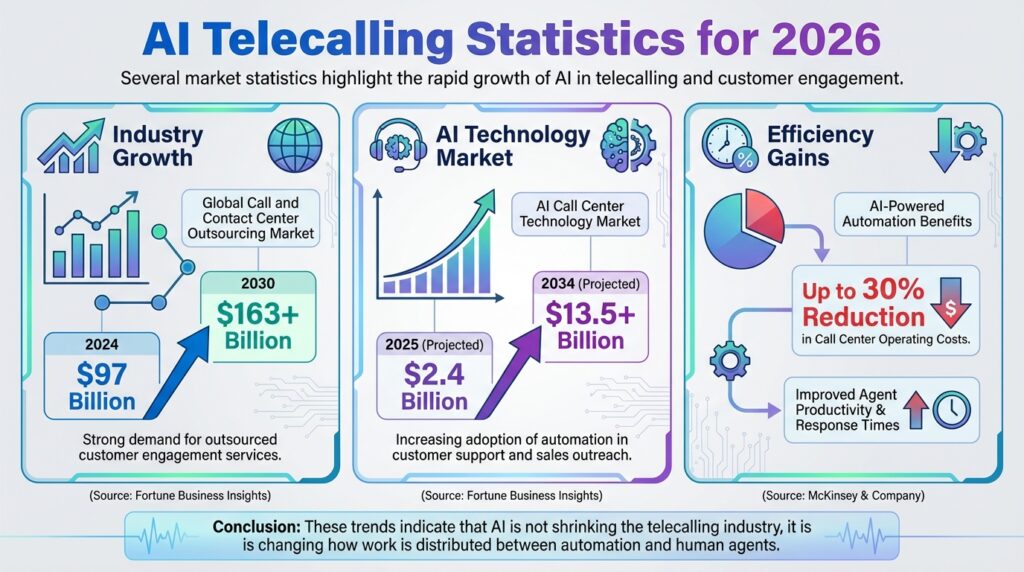
Several market statistics highlight the rapid growth of AI in telecalling and customer engagement.
Industry Growth
The global call and contact center outsourcing market was valued at about $97 billion in 2024 and is projected to reach more than $163 billion by 2030, reflecting strong demand for outsourced customer engagement services.
(Source: Grand View Research)
AI Technology Market
The AI call center technology market is expected to grow from roughly $2.4 billion in 2025 to more than $13.5 billion by 2034, as companies increasingly adopt automation in customer support and sales outreach.
(Source: Fortune Business Insights)
Efficiency Gains
AI-powered automation can reduce call center operating costs by up to 30% while improving agent productivity and response times.
(Source: McKinsey & Company).
These trends indicate that AI is not shrinking the telecalling industry, it is changing how work is distributed between automation and human agents.
Why This Is Increasing Gig Telecaller Demand
One of the most important economic impacts of AI telecalling is the shift toward flexible workforce models.
AI outreach systems can generate large volumes of qualified leads very quickly. However, businesses still require human agents to manage complex conversations with interested prospects.
Because these lead volumes often fluctuate, companies are increasingly adopting elastic staffing models.
Instead of maintaining large permanent call center teams, organizations hire freelance telecallers to manage spikes in customer interactions.
Several factors drive this trend:
On-Demand Human Interaction
AI can generate thousands of qualified leads in a short period. Companies often need temporary telecalling capacity to handle this surge in high-intent conversations.
Gig workers allow businesses to scale their telecalling teams quickly.
Project-Based Outreach Campaigns
Modern sales campaigns are often short-term and targeted. Companies may run a two-week outreach campaign for a new product or service.
Hiring full-time employees for such campaigns is inefficient, so businesses rely on freelance telecallers.
Global Remote Workforce
Remote work technologies allow companies to hire telecallers from anywhere in the world.
A company in the United States can easily hire remote telecallers in India, the Philippines, or Europe to manage global outreach.
Cost Efficiency
Gig workers allow businesses to control operational costs. Instead of paying salaries year-round, companies pay telecallers only when campaigns are active.
These factors are contributing to rapid growth in the outsourcing and gig telecalling ecosystem.
The global call center outsourcing market is projected to reach $259 billion by 2034, reflecting increasing demand for flexible customer interaction services.
Cost Efficiency: A Major Driver Behind the Rise of Gig Telecalling
Beyond technological innovation, cost efficiency is one of the most significant reasons businesses are adopting gig telecalling models.
Traditional call centers operate with a fixed cost structure. Companies must maintain full-time agents, pay salaries regardless of call volume, and invest in physical infrastructure such as office space, telecom systems, and management operations.
This model becomes inefficient when call volumes fluctuate.
AI-powered telecalling systems change this dynamic by generating qualified leads in bursts. Businesses often experience spikes in customer responses following automated outreach campaigns.
Instead of maintaining large permanent teams, companies increasingly rely on freelance telecallers who can handle these interactions on demand.
This model provides several cost advantages:
Lower fixed operational costs
Pay-for-campaign workforce models
Reduced infrastructure requirements
Access to global talent pools
For many organizations, the combination of AI automation and gig-based telecalling creates a more scalable and cost-efficient customer engagement system.
Real Industry Examples
The AI-assisted telecalling model is already visible across multiple industries.
SaaS Sales
Software companies often use AI voice systems to contact large lists of potential business customers. Interested prospects are then transferred to human sales representatives.
Insurance
Insurance providers use automated calling systems to inform customers about policy updates or renewal options. Human agents handle detailed consultations and policy sales.
Real Estate
Property companies use AI-based calling campaigns to contact potential buyers and schedule property tours.
Fintech
Financial technology firms use AI to pre-screen customers for loan eligibility before transferring qualified leads to telecallers.
EdTech
Education platforms frequently use AI calling systems to reach students who signed up for webinars or free courses. Telecallers then convert these leads into paid enrollments.
In all these cases, AI accelerates the initial outreach stage, while human agents drive the final conversion.
5 New Gig Telecalling Roles Created by AI (2026-2030)
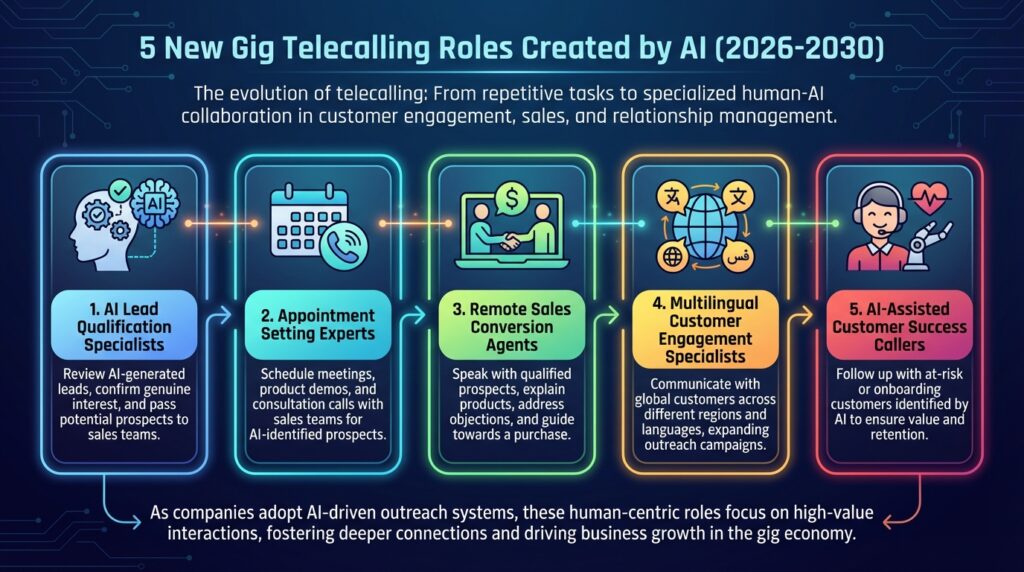
As AI automation becomes a core part of customer outreach, the nature of telecalling jobs is evolving. Instead of performing repetitive cold-calling tasks, modern telecallers are increasingly handling specialized roles that focus on customer engagement, sales conversations, and relationship management.
Between 2026 and 2030, several new gig-based telecalling roles are expected to emerge as companies adopt AI-driven outreach systems.
AI Lead Qualification Specialists
AI tools can identify potential prospects quickly, but businesses still need human agents to confirm whether those leads are genuinely interested. Lead qualification specialists review AI-generated leads, ask follow-up questions, and determine whether the prospect should be passed to a sales team.
Appointment Setting Experts
Once AI systems identify interested prospects, appointment setters step in to schedule meetings, product demos, or consultation calls with sales teams. This role is common in industries like SaaS, insurance, consulting, and real estate.
Remote Sales Conversion Agents
AI can start conversations, but closing deals still requires human persuasion. Remote sales conversion agents speak with qualified prospects, explain products in detail, address objections, and guide customers toward making a purchase.
Multilingual Customer Engagement Specialists
As companies expand globally, they need telecallers who can communicate with customers in multiple languages. These specialists help businesses run outreach campaigns across different regions and improve engagement with international customers.
AI-Assisted Customer Success Callers
AI systems can identify customers who need onboarding support or may be at risk of leaving a service. Customer success callers follow up with these customers, answer questions, and help them get the most value from the product or service.
AI Telecalling Market Trends Businesses Should Watch (2026–2030)
As AI technologies continue to evolve, the telecalling industry is expected to undergo several structural changes over the next few years. Businesses that rely on customer outreach and sales calls will increasingly adopt hybrid systems that combine automation with human expertise.
Here are some key trends that are likely to shape the future of telecalling between 2026 and 2030.
Hybrid AI-Human Call Centers Will Become Standard
Rather than replacing human agents, most organizations are adopting hybrid call center models where AI handles repetitive tasks and human telecallers manage complex interactions. AI systems will take care of initial outreach, basic information collection, and call routing, while human agents focus on conversations that require persuasion, empathy, and deeper product understanding.
AI Will Dramatically Increase Lead Generation
AI-powered dialing systems and voice bots can reach thousands of prospects within minutes. This significantly increases the number of leads entering the sales pipeline. While automation can identify interested prospects, businesses still rely on human telecallers to manage these high-intent conversations and convert them into customers.
Gig-Based Telecalling Workforces Will Expand
As AI generates leads at a much faster pace, companies will increasingly adopt flexible hiring models. Instead of maintaining large permanent call center teams, many organizations will rely on freelance telecallers and remote agents who can scale up or down depending on campaign demand.
Multilingual Outreach Will Grow as Businesses Expand Globally
Companies are expanding their customer outreach beyond domestic markets. While AI tools can assist with translation and localization, human telecallers are still needed to communicate effectively with customers in different languages and cultural contexts. This will increase demand for multilingual telecallers across global markets.
AI Will Augment Telecallers With Smart Tools
AI will increasingly act as a support system for telecallers rather than a replacement. Tools such as real-time conversation analytics, automated call summaries, sentiment detection, and predictive customer insights will help agents handle conversations more efficiently and improve overall customer experience.
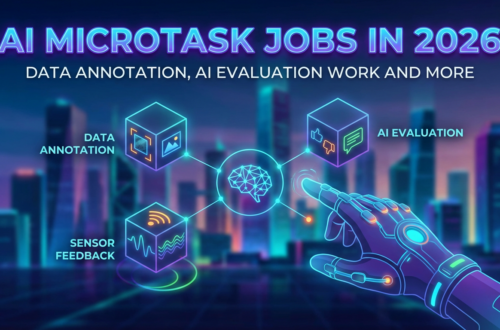
The Rise of AI Microtask Jobs
The growth of AI-powered systems is also creating new types of work beyond telecalling. As companies deploy AI models for automation, they increasingly rely on human workers to support tasks like data labeling, content review, and AI training.
These small, task-based opportunities, commonly known as AI microtasks, are becoming a major part of the gig economy.
If you’re interested in exploring this emerging category of remote work, you can learn more about AI microtask opportunities and how they are shaping the future of freelance work in this guide:
👉 https://blog.truelancer.com/ai-microtask-jobs-2026/
Challenges and Ethical Concerns
Despite its benefits, AI-driven telecalling also introduces several challenges.
One concern is the potential misuse of AI voice technologies. AI-generated voices can be used for fraudulent calls or impersonation.
In fact, reports indicate that about one-third of consumers in the U.S. encountered synthetic voice fraud in 2024, highlighting the risks associated with voice AI.
Another challenge is maintaining authenticity in customer interactions. Overuse of automation can reduce trust if customers feel they are interacting only with machines.
Regulatory compliance is also becoming more important as governments introduce rules around automated calling and AI transparency.
Businesses must balance efficiency with responsible AI use.
(Source: U.S. Federal Communications Commission – AI Robocall Ruling)
Telecalling in 2026-2030: What Happens Next
Looking ahead, AI and human telecallers will increasingly work together in what analysts describe as hybrid AI-human call centers.
Several trends are expected to shape the industry over the next five years:
AI Will Handle the First 50% of Customer Interaction
Voice bots and conversational AI will manage early-stage outreach, information collection, and basic support requests.
Human Telecallers Will Focus on High-Value Conversations
Human agents will handle complex discussions such as sales negotiations, customer retention, and relationship building.
Gig Telecallers Will Become a Core Workforce
Companies will rely more on remote freelance telecallers to handle fluctuating outreach campaigns instead of maintaining large permanent call center teams.
Global Talent Networks Will Expand
Businesses will increasingly hire telecallers from global freelance marketplaces, allowing them to run outreach campaigns across multiple regions and languages.
By 2030, many organizations are expected to operate AI-assisted distributed call centers, combining automation technology with gig-based human talent.
Conclusion
The rise of AI in telecalling has sparked widespread debate about the future of call center jobs. While automation has eliminated some repetitive tasks, it has also created new opportunities for skilled human telecallers.
AI now handles the scale of outreach, rapidly contacting thousands of potential customers and filtering leads based on interest. Human telecallers step in where their skills matter most, building trust, handling objections, and closing deals.
This transformation is also fueling the growth of gig-based telecalling work. Businesses increasingly rely on flexible freelance telecallers who can manage high-intent leads generated by AI-driven outreach campaigns.
In other words, AI is not replacing telecallers; it is redefining their role in the customer engagement process.
As technology continues to evolve, the most successful organizations will be those that combine the speed of AI with the empathy and persuasion of human communication.
And in this hybrid future, telecallers may become more valuable than ever.
Frequently Asked Questions (FAQ)
Does AI replace telecallers?
No. AI is primarily used to automate repetitive tasks such as dialing, collecting basic information, and qualifying leads. Human telecallers are still essential for handling complex conversations, answering detailed questions, building trust with customers, and closing sales.
What is AI telecalling?
AI telecalling refers to the use of AI voice agents powered by technologies like natural language processing (NLP) and neural text-to-speech (TTS) to conduct real-time, human-like conversations with customers. These agents automate tasks such as answering queries, qualifying leads, and scheduling appointments, while human agents focus on complex interactions. AI voice agents help businesses scale customer support efficiently without replacing human expertise.
Why are companies using AI in call centers?
Businesses use AI in call centers to improve efficiency and reduce operational costs. AI tools can automate routine interactions, analyze customer responses, and route calls more effectively. This allows human agents to focus on high-value conversations that require problem-solving and relationship building.
How is AI creating opportunities for gig telecallers?
AI-powered outreach systems can generate large numbers of qualified leads quickly. Companies often need flexible human agents to handle these leads, which is why many businesses now hire freelance telecallers or gig workers to manage high-intent conversations and sales calls.
Which industries use AI telecalling the most?
AI telecalling is widely used in industries that rely heavily on customer outreach and lead generation, including SaaS, fintech, insurance, real estate, education technology, and e-commerce.
What skills are important for telecallers in an AI-driven industry?
As telecalling evolves, agents who can build trust with customers, communicate clearly, handle objections, and explain products effectively will remain highly valuable. Communication skills, sales expertise, and customer engagement abilities are increasingly important in AI-assisted telecalling roles.
Can freelancers work in AI-assisted telecalling roles?
Yes. Many companies now hire remote telecallers and freelance agents to support outreach campaigns generated through AI tools. Freelancers can work as appointment setters, sales conversion agents, customer support callers, or multilingual engagement specialists.
Hire Telecallers for AI-Driven Outreach
As AI tools accelerate lead generation, businesses often need skilled telecallers who can manage qualified prospects and close conversations effectively.
Companies can hire remote telecallers, sales agents, and appointment setters through freelance marketplaces that provide access to global talent pools.
Platforms like Truelancer allow businesses to connect with experienced telecalling professionals who can handle outbound sales, lead qualification, and customer engagement campaigns.
- Hire Telecallers
- Hire Customer Support Experts
- Hire Sales Representatives
- Hire Remote Call Center Agents



One comment on “The Future of Customer Support in 2026: How AI Voice Agents Are Driving the Rise of Gig Telecallers”
Comments are closed.