AI is growing fast. Companies everywhere are using it to handle customer service, write content, review documents, screen job applications, and support sales teams. But there is one side of this story that does not get nearly enough attention.
What happens when an AI product goes wrong?
Not because of a coding bug. Not because the internet went down. But because someone figured out how to make the AI say things it was never supposed to say, share information it was never supposed to share, or behave in a way that puts the company and its customers at real risk.
This is exactly the problem that AI Red Teamers are trained to solve. And in 2026, their work is becoming one of the most in-demand skills in the entire AI industry.
Key Takeaways
- The global AI market is projected to grow from $71 billion in 2025 to over $890 billion by 2032, bringing both enormous opportunity and serious safety challenges. (Source: MarketsandMarkets)
- The AI trust and safety market is expected to reach $7.44 billion by 2030, growing at over 21% per year. (Source: Grand View Research)
- Only 1.5% of companies say they have enough people to handle AI safety properly, creating a massive gap between demand and available talent. (Source: IAPP, 2025)
- AI red teaming is becoming a recognized professional role across technology, finance, healthcare, and government sectors worldwide.
- Freelancers and gig professionals are well-positioned to enter this field, as most companies need project-based testing rather than permanent staff.
What Exactly Is Going Wrong With AI Right Now?
Before we talk about the role itself, it helps to understand why it exists.
Most people assume that once a company builds an AI product and tests it, it is safe to use. The reality is more complicated than that. AI systems do not follow fixed rules the way traditional software does. They make judgment calls based on patterns learned from huge amounts of data. And those judgment calls can go wrong in surprising ways, especially when someone is deliberately trying to push them in the wrong direction.
Here are a few examples of what can go wrong:
The AI forgets its own rules. Someone phrases a request in a clever way and the AI starts producing content it was specifically told never to produce. This is called a jailbreak, and techniques for doing this are shared widely online.
Hidden instructions get smuggled in. Someone puts a hidden command inside a document or web page that the AI reads, and the AI follows that hidden command without realizing anything unusual happened. This is called prompt injection, and it is considered one of the most serious risks in modern AI systems.
The AI gives wrong answers with total confidence. An AI chatbot on a healthcare website tells someone incorrect information about their medication. The person trusts it because the AI sounds completely certain. These confident wrong answers are called hallucinations, and they are a real liability risk for companies.
Private information gets leaked. An AI system, when pushed in the right direction, starts repeating information it was trained on or has access to, including things it absolutely should not share.
These are not rare edge cases. They are documented, recurring patterns across products from companies of all sizes. And the bigger AI gets, the bigger the stakes when something goes wrong.
What Is an AI Red Teamer?
The concept of a “red team” comes from military strategy. During the Cold War, the U.S. military created special groups whose only job was to think like the enemy and try to defeat their own defences. The idea was simple: if you can find your own weaknesses before your enemies do, you can fix them first.
Cybersecurity borrowed this approach, and so did AI safety.
An AI Red Teamer is a professional who gets paid to try to break AI systems on purpose. Not randomly, not maliciously, but in a structured, methodical way that helps companies understand exactly where their AI products are vulnerable.
Think of it like hiring someone to try to break into your own building before you open it to the public. A good red teamer does not just rattle the front door. They check the windows, test the fire exits, try the staff entrance, look for blind spots in the security cameras. Their entire job is to find problems so the team can fix them.
In AI terms, that means:
- Sending carefully crafted messages to see if the AI’s safety rules can be bypassed
- Testing whether the AI will reveal its confidential setup instructions when pushed
- Creating realistic scenarios that mimic how a bad actor might behave across multiple messages
- Checking whether the AI behaves consistently across different languages
- Writing detailed reports that explain what was found and how to fix it
This is not the same as standard software testing, which checks whether a product works as intended. Red teaming is specifically about finding what happens when someone is actively trying to make it fail.
Why This Role Is So Important Right Now
A few years ago, most AI tools were used by a small number of internal users. If something went wrong, the impact was limited and easy to contain.
That has completely changed.
AI is now embedded in products that serve millions of customers every day. Banks use it for customer queries. Insurance companies use it to explain policies. Hospitals use it to support patient communication. Schools use it to help students. Online stores use it for customer service around the clock.
When AI operates at that scale, a safety gap is not just an embarrassment. It can cause real financial damage, legal liability, and lasting harm to the people the product is supposed to serve.
At the same time, the people trying to exploit AI systems are getting more sophisticated. Techniques for tricking AI products are shared openly on the internet. What one person discovers, thousands can copy within days.
The organizations that have been doing this the longest understand the stakes. Companies like OpenAI and Anthropic run structured red teaming for every major product they release, bringing in outside professionals from multiple countries specifically to challenge their systems before launch. The fact that the largest AI companies in the world, with their own full internal safety teams, still hire external testers tells you a great deal about how important this kind of work is considered.
What AI Red Teamers Actually Do: The Day-to-Day Work
The work itself is more creative than most people expect. Here is what a typical engagement actually looks like.
Finding safety bypass techniques The tester spends time crafting messages and scenarios designed to push the AI into producing outputs it was specifically told not to produce. This requires creativity and persistence. When they find something that works, they document exactly what they did, why it worked, and what a bad actor could do with the same technique.
Testing hidden instruction attacks The tester creates scenarios where instructions are hidden inside documents, web pages, or messages that the AI might read and act on. This is especially important for AI systems that are connected to the internet or that read user-uploaded files.
Trying to expose secret setup instructions Many AI products operate with a confidential setup that defines their personality, their rules, and their limits. Testers try to trick the AI into revealing these instructions through indirect questions, because exposing this information could give competitors or bad actors a significant advantage.
Building multi-message attack scenarios The most sophisticated testing involves building entire conversations designed to gradually push the AI in a harmful direction. This mirrors how a real bad actor might behave, patiently and persistently, across many messages over time.
Writing professional reports This is where a lot of the real value lives. Finding a problem is only useful if you can explain it clearly enough that the team responsible for the product can fix it. A good red teaming report explains what the problem is, how to reproduce it, how serious it is, and what to do about it.
Working with the product team Red teamers do not just hand over a document and disappear. They work alongside product and safety teams to help them understand the findings and prioritize what to address first.
The Industries That Need This Work Most
AI red teaming is relevant across virtually every sector that uses AI to interact with customers or make decisions. But some industries feel the pressure more acutely than others.
Financial services Banks, insurance companies, and investment platforms use AI for customer queries, fraud detection, and lending decisions. Errors in any of these areas carry direct legal and financial consequences.
Healthcare Hospitals and health platforms use AI to answer patient questions, support clinical staff, and manage appointments. Wrong answers in this context can cause genuine physical harm.
SaaS and technology Software companies use AI for sales outreach, customer onboarding, and support. Jailbreaks and data leaks in these products can damage customer trust and trigger serious consequences.
Education EdTech platforms use AI to support students with learning, feedback, and guidance. Safety failures here can have a significant impact on vulnerable young users.
Real estate and fintech Both industries use AI for lead qualification and customer consultation. Misinformation or safety failures in these contexts can have significant legal implications.
In all of these sectors, the cost of something going wrong is high enough that structured safety testing is quickly moving from a nice-to-have to a requirement.
The Market Behind This Role
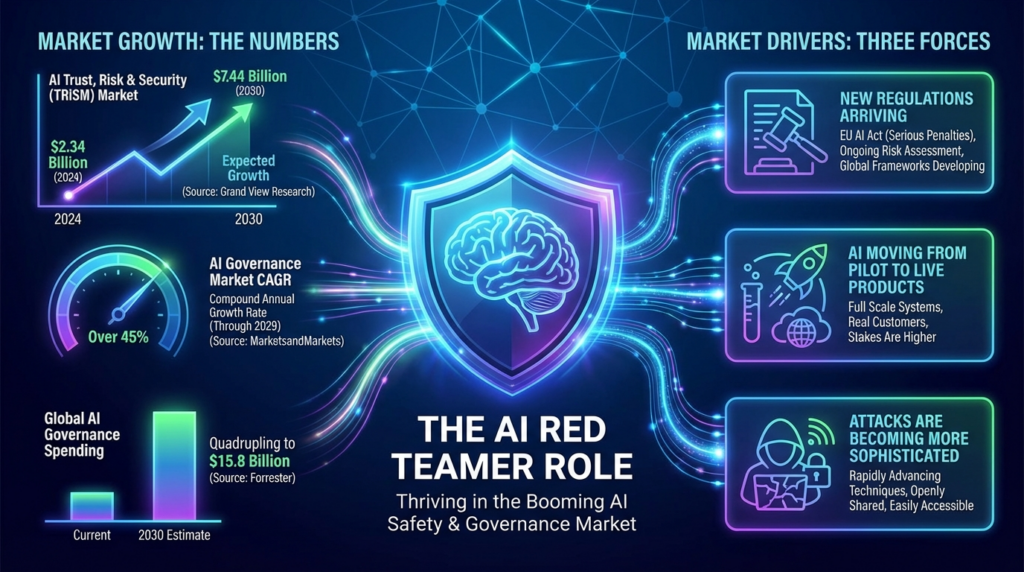
The numbers behind AI safety and governance tell a clear story about where investment is going.
The AI trust, risk, and security management market was valued at $2.34 billion in 2024 and is expected to grow to $7.44 billion by 2030. (Source: Grand View Research)
The AI governance market is growing even faster, with some analysts projecting a compound annual growth rate of over 45% through 2029. (Source: MarketsandMarkets)
Research firm Forrester estimates that spending on AI governance tools will more than quadruple by 2030, reaching $15.8 billion globally.
What is driving all of this? Three things are happening at once.
New regulations are arriving. The EU AI Act, which now affects any company operating in or selling into Europe, requires companies to assess and monitor the risks of their AI systems on an ongoing basis. Penalties for non-compliance are serious. Similar regulatory frameworks are being developed in the United States and across Asia.
AI is moving from pilot programs to live products. Companies that spent 2022 and 2023 running small AI experiments are now running those systems at full scale with real customers. That shift changes everything about what is at stake.
Attacks are becoming more sophisticated. The techniques used to exploit AI systems are advancing rapidly, and they are being shared openly. What required specialized knowledge a year ago is now accessible to almost anyone willing to spend a few hours online.
Why Testing Cannot Happen Just Once
One of the most common mistakes companies make with AI safety is treating it as a one-time checklist.
Run the tests before launch. Tick the box. Move on.
The problem is that AI is not a static product. Models get updated. New features get added. The AI connects to new data sources. And the wider environment keeps changing, with new attack techniques discovered and shared constantly.
A safety assessment that was accurate six months ago may not reflect what the product is capable of doing today.
The most thoughtful AI companies treat safety testing as an ongoing function, not a launch milestone. Multiple rounds of testing, tied to product updates and changes in the threat landscape, is what responsible deployment actually looks like.
For companies that cannot run this internally, which is most companies, that creates a clear and recurring need for external red teaming expertise.
Skills You Need to Enter This Field
The encouraging news for anyone interested in AI red teaming is that this is not a role that requires years of specialized background. What it requires is the right combination of practical skills and a specific way of thinking.
Technical skills to build:
- Basic Python coding to work with AI tools and APIs
- An understanding of how AI language models process instructions
- Familiarity with common attack techniques like prompt injection
- Experience testing software through its API using tools like Postman
- Knowledge of the OWASP LLM Top 10, the most widely used framework for understanding AI-specific risks
What makes someone genuinely good at this work:
- The ability to think like someone who wants to cause problems, not someone who wants to make things work
- Patience and persistence when testing does not immediately produce results
- Strong writing skills, because a finding that cannot be clearly explained is a finding that does not get fixed
- Curiosity about edge cases and unusual scenarios
What gives you an advantage over time:
- Background in a specific industry such as healthcare, finance, or law. Companies in regulated sectors pay a significant premium for testers who understand the context of their work.
- A second or third language. Many AI products have weaker safety protections in languages other than English, which makes multilingual testers particularly valuable.
A Practical Path to Getting Started
Getting into AI red teaming does not require going back to school or spending money on expensive courses. Here is a realistic path from beginner to first paid engagement.
First two months: Build the foundation Start with the OWASP LLM Top 10. Read it properly, not just skim it. This gives you the vocabulary and conceptual framework that the entire field works from. Build basic Python skills using freeCodeCamp if you do not already have them. Start experimenting with AI API testing using Postman.
Month two to three: Start testing Download Ollama to run open-source AI models on your own computer at no cost. This gives you a safe environment to practice without worrying about costs or terms of service. Try automated testing tools like Garak or Microsoft’s PyRIT to understand how structured vulnerability scanning works. For everything you find, write it up as if it were a professional report.
Month three to four: Build a visible track record Sign up for bug bounty programs on HackerOne and Bugcrowd. Both platforms now include AI-specific scope categories where you can submit real findings. Even when no payment is involved, the practice of submitting structured reports builds professional credibility. Share what you are learning on LinkedIn. In a field this new, being publicly visible and consistent gets you noticed.
The most important output of this four-month period is a small portfolio of well-written reports. Five solid findings documents will open more doors than any certification currently available.
New Roles Being Created by the Growth of AI Red Teaming
As more companies build AI safety into their operations, several specialized roles are emerging that sit within or alongside the red teaming discipline.
AI Safety Evaluators These professionals focus on structured testing of AI systems before and after launch, documenting findings across a range of risk categories and working with product teams to prioritize fixes.
Prompt Injection Specialists With prompt injection recognized as one of the most serious AI vulnerabilities, some testers are building deep specialization in this specific area, particularly for companies running agentic AI systems that connect to the internet or take real-world actions.
Multilingual AI Testers Global companies are realizing that safety filters built for English often fail in other languages. Testers who can challenge an AI system in Hindi, Arabic, French, Mandarin, or other major languages are increasingly sought after.
AI Compliance Reviewers As regulations like the EU AI Act come into enforcement, companies need professionals who can assess AI products against specific legal requirements. This role combines red teaming knowledge with regulatory awareness.
Freelance AI Safety Consultants Rather than working for a single employer, many practitioners are building independent consulting practices, working with multiple companies across different sectors on project-based engagements.
What AI Red Teamers Earn
Because this is a relatively new field with far more demand than supply, the earnings potential is genuinely strong.
| Type of Work | What It Involves | What It Pays |
|---|---|---|
| Freelance project | Testing a single AI product or model | $2,000 to $8,000 per project |
| Bug bounty | Reporting a critical security finding | $500 to $10,000+ per finding |
| Monthly retainer | Ongoing advisory and testing | $5,000 to $20,000 per month |
| Enterprise assessment | Full safety review of an organization’s AI | $25,000 to $100,000+ |
| Full-time role (US) | Senior in-house AI red teamer | $130,000 to $220,000 per year |
These rates reflect a simple reality. There are far more companies that need this work done than there are people who can do it. According to the IAPP’s 2025 AI Governance Profession Report, only 1.5% of organizations believe they have enough people to manage AI safety properly. That gap is the main reason this work commands the rates it does, and that gap is not going to close quickly.
Why Freelancers Are Well-Positioned for This Opportunity
AI red teaming is not the kind of work most companies need someone doing full-time, year-round. They need intensive, focused testing at specific moments: before a product launch, after a major update, during an annual compliance review, or when something has already gone wrong.
This project-based demand is a natural fit for freelance work.
There is also a genuine business case for using multiple independent testers rather than relying on one permanent hire. A single tester, no matter how skilled, brings one perspective. Different testers bring different backgrounds, different languages, different ways of approaching a problem. What one person misses, another might catch. The leading AI companies in the world build this diversity of perspective into their own testing programs deliberately.
Platforms like Truelancer already connect businesses that need this kind of project-based AI safety work with qualified professionals who can deliver it. For freelancers building skills in this area, this is exactly the kind of demand that a gig-based career can be built around.
What the Next Five Years Look Like
The AI safety field is still early. The professional standards, training programs, and certification structures are all still being built. That is actually a significant advantage for anyone entering now, because the people who develop expertise and reputation during this formation period will shape what the field looks like as it matures.
Several things are likely to happen between now and 2030.
Red teaming will become a standard requirement for enterprise AI. Just as security audits became a normal part of software development over the past two decades, adversarial AI testing will become an expected step in responsible deployment.
Regulatory requirements will make ongoing testing mandatory in more industries. As governments catch up with AI’s growth, regular safety assessment will move from best practice to legal requirement in sectors like finance, healthcare, and critical infrastructure.
Demand for specialists will outpace the supply of generalists. As the field matures, companies will increasingly want testers with deep expertise in specific risk areas or specific industries, rather than broad generalists.
The gig model will grow. As AI generates more products that need safety assessment, and as companies become more comfortable with distributed, project-based expertise, freelance AI red teaming will become a recognized career track with its own ecosystem of tools, platforms, and professional communities.
Conclusion
The story of AI in 2026 is not just about what AI can do. It is about whether what AI does can be trusted.
Every company deploying AI into the world needs people who will challenge it, probe it, and find its weaknesses before someone else does. That work requires a specific combination of technical knowledge, adversarial thinking, and communication skill. And right now, the people who can do it well are in very short supply.
AI red teaming is not a niche specialty for elite researchers. It is an accessible, learnable, practical discipline with strong earning potential, a natural fit for freelance work, and a clear path to entry for anyone willing to put in the time to build the right skills.
The opportunity window is open. The demand is real. And the field is being built right now by the people willing to step into it.
Frequently Asked Questions:
What is AI red teaming and why do companies need it?
Answer:
AI red teaming is the practice of deliberately trying to find problems with an AI system before those problems affect real users. A red teamer approaches the AI as someone trying to make it fail rather than someone trying to make it work, which is a fundamentally different mindset from standard testing.
Companies need it because AI systems can behave in unexpected and potentially harmful ways when pushed in the wrong direction. Standard quality testing does not catch these kinds of failures. Structured adversarial testing does.
Is this the same as cybersecurity?
Answer:
Not exactly. The two share some foundational thinking, particularly the idea of looking for vulnerabilities and documenting them clearly. But AI red teaming targets how AI models respond to language and instructions, which is a completely different set of risks from traditional software or network security.
You do not need a cybersecurity background to enter this field, though the analytical mindset that good security professionals develop is genuinely helpful.
Do I need a technical degree to get into this?
Answer:
No degree is required. The skills you need are learnable through free resources and hands-on practice. Basic Python, an understanding of how AI models work, familiarity with the OWASP LLM Top 10 risk framework, and strong written communication are the core building blocks.
What matters most to hiring managers right now is a portfolio of documented findings. Practical demonstrated skill will carry you further than any formal qualification in a field this new.
Can freelancers work in this field?
Answer:
Yes, and the structure of the demand actually favors freelancers. Companies need intensive testing at specific moments rather than a full-time staff member working every day. Project-based, freelance engagements are the most common way this work gets done, even at companies with large internal safety teams who bring in outside testers for fresh perspectives.
Platforms like Truelancer connect businesses with AI safety professionals available for exactly these kinds of engagements.
How long does it take to be ready for a paid engagement?
Answer:
With consistent effort, most people can reach a competitive level for their first freelance engagement within 90 to 120 days. The key milestones are completing the OWASP LLM Top 10, building hands-on testing experience with free tools like Ollama and Garak, and putting together a small portfolio of well-written findings reports.
A portfolio of five solid reports will open more doors than years of coursework without practical application.
How much can an AI red teamer earn?
Answer:
Earnings vary widely based on experience and engagement type. Freelance projects typically run $2,000 to $8,000 per engagement. Bug bounty findings can pay anywhere from a few hundred dollars to $10,000 or more for critical discoveries. Senior full-time roles at U.S. companies currently pay $130,000 to $220,000 per year.
The rates are strong and likely to hold because qualified practitioners are genuinely hard to find. Supply is not keeping up with demand, and that gap favors people entering the field right now.
Which industries are hiring AI red teamers the most?
Answer:
Technology, financial services, healthcare, insurance, and education are currently the most active hiring sectors. Government agencies and regulatory bodies are also building AI evaluation capabilities. Any organization deploying AI in a context where failure could cause serious harm to customers is increasingly investing in structured safety testing.
Hire AI Red Teamers on Truelancer
As more organizations deploy AI across customer-facing products and internal workflows, the need for qualified adversarial testing is growing at the same pace.
Truelancer connects businesses with experienced AI professionals capable of conducting red teaming, prompt injection testing, and AI safety assessments on a project basis. Whether you are preparing for a product launch, working through a compliance review, or investigating a specific safety concern, the platform gives you access to vetted specialists without the overhead of full-time hiring.
For businesses ready to take AI safety seriously, the starting point is to hire AI developers and safety specialists with the expertise to find problems before your users do.
For professionals building skills in this area, Truelancer provides direct access to companies actively looking for AI red teaming expertise across industries and regions.Share